
JUPITER SEA & AIR SERVICES PVT. LTD, EGMORE – CHENNAI, INDIA.
E-MAIL : Robert.sands@jupiterseaair.co.in Mobile : +91 98407 85202
Corporate News
Letter for Wednesday September 30, 2026
Today’s
Exchange Rates
|
Currency ▲ |
Price |
Change |
%Change |
Open |
Prev.Close |
Day's Low-High |
|
95.98 |
-0.009995 |
-0.010412 |
96.02 |
95.99 |
95.95 - 96.1575 |
|
|
1.1351 |
-0.002 |
-0.175884 |
1.1371 |
1.1371 |
1.1333 - 1.1374 |
|
|
126.9212 |
-0.339096 |
-0.266459 |
127.2257 |
127.2603 |
126.9212 - 127.3346 |
|
|
108.7889 |
-0.396896 |
-0.363505 |
109.1562 |
109.1858 |
108.768 - 109.2572 |
|
|
157.184 |
-0.205994 |
-0.130881 |
157.39 |
157.39 |
156.983 - 157.719 |
|
|
1.3241 |
-0.0014 |
-0.10562 |
1.3255 |
1.3255 |
1.3221 - 1.3258 |
|
|
0.6087 |
-0.0024 |
-0.392741 |
0.6099 |
0.6111 |
101.177 - 101.475 |
/// Sea Cargo News ///
India Explores Sohar,
Fujairah Routes to Avoid Hormuz

India is exploring alternative routes through Sohar in Oman and Fujairah in the UAE to maintain oil supplies while reducing dependence on shipments passing through the Strait of Hormuz.
The route diversification comes as security
concerns around the strategic chokepoint have increased, prompting
oil-importing countries and energy companies to assess alternative supply and
transportation options.
Sohar and Fujairah provide access to ports
outside the Strait of Hormuz, allowing crude and petroleum products to be moved
through alternative maritime and land-based logistics networks.
Fujairah, located on the Gulf of Oman, is
already a major regional hub for oil storage, bunkering and energy trading. For
India, greater use of these routes could provide additional flexibility in
managing crude supplies and reduce exposure to disruptions affecting vessels
transiting Hormuz.
However, the feasibility of alternative
routes will depend on available port capacity, pipeline and storage
infrastructure, transportation costs and regional security conditions.
India is one of the world’s largest crude oil
importers, making reliable maritime supply routes critical to its energy
security and refinery operations. Any sustained shift toward alternative
corridors could also influence regional tanker movements, freight costs and
crude supply chains.
The Suez
Route Is Returning. The Voyage Is Not Yet Normal.

By Hugo Federico Hernandez Varela
The return of container services to the Suez
Canal is becoming increasingly visible. What is less clear is when the
underlying operation can genuinely be described as normal again.
Operational normalisation is broader than a
vessel transiting Suez: schedules, port rotations, cargo sequencing, equipment
positioning and delivery expectations also have to settle around a stable
baseline.
Other carriers are also restoring Suez
routing, but not as a simple switch.
MSC’s Indusa service illustrates the point.
Westbound cargo is returning through the Red Sea, beginning with MSC Domna X
departing Colombo on 23 September, while eastbound cargo continues around the
Cape of Good Hope. MSC says the transition will be implemented case by case,
with contingency arrangements remaining in place.
CMA CGM and its Ocean Alliance partners show
a similar directional split. FAL3 is returning through Suez on its eastbound
North Europe-to-Asia leg, while the westbound leg remains routed around the
Cape.
The route, in other words, may be returning
before the network has returned to a single operating pattern.
A shorter route does not immediately recreate
the old operation
The obvious benefit of Suez is distance.
Compared with Cape routing, a Canal transit can shorten the physical voyage
between Asia and Europe and ultimately release vessel capacity.
But liner networks are not isolated voyages.
During the extended Cape-routing period,
vessels shifted rotations, equipment circulated through longer cycles,
transshipment arrangements adapted and cargo owners planned against longer
transit assumptions. Changing the geographical route does not reset those
elements simultaneously.
A booking made against one expected rotation
may ultimately move under another. A shorter sea passage may alter port
sequence or transshipment. A vessel can recover sailing time while the
terminal, equipment or inland chain is still working against the timetable
created by the Cape pattern.
The relevant distinction is therefore between
nominal capacity and operationally usable capacity. The ship exists in both
cases. The question is whether its position, schedule and cargo sequence allow
that capacity to be used as the customer expected when the booking was made.
Normalisation is becoming asymmetric
Different services — and even different
directions within the same service — are operating under different routing
assumptions.
A westbound cargo may pass through Suez while
the return leg still goes around the Cape; another service may remain entirely
on the longer route.
For cargo interests, the useful question is
no longer simply: Has the carrier returned to Suez?
It is: Which service, which direction, which
sailing — and against which booking assumption?
Why cost can outlive the disruption that
created it
From 15 September, MSC introduced a Piracy
Risk Surcharge of US$55 per TEU and a Suez Canal Surcharge of US$36 per TEU on
cargo from Asia to specified East Mediterranean and Black Sea destinations — a
combined US$91 per TEU.
At first glance, new Suez-related charges
appearing while ships are returning to the Canal may look contradictory.
Operationally, they are not necessarily so.
A carrier can resume selected Suez transits
while maintaining contingency options and carrying security exposure across an
unstable network. Some costs disappear quickly; others — network repositioning,
schedule uncertainty and contingency planning — unwind more slowly.
This creates a period in which the physical
voyage can become shorter before the commercial environment around it becomes
normal.
The allocation question comes next
This is where the transition becomes more
than a network story.
The residual cost rarely sits where the
headline puts it. It sits in the documents that attach that cost to a
particular shipment.
Take a surcharge applied by proforma sailing
date. A cargo can be quoted and booked before the surcharge exists, yet still
become subject to it because the vessel’s relevant proforma date falls after
the charge takes effect.
Now place that cargo on a service whose
routing changes during the return to Suez.
The performed voyage may no longer follow the
rotation assumed at booking. A transshipment point may move. A free-time clock
may start under a different operational sequence. A local tariff may attach at
a different interface. Delivery timing can shift even though the sea passage
itself has become shorter.
At that point, the practical argument is no
longer whether Suez has reopened.
It is what the booking confirmation
contemplated, what route was actually performed, which tariff or surcharge rule
attached to that sailing, and which contractual document governs the
consequence of the change.
That is why the operational sequence has to
be reconstructed before the commercial position can be understood.
There is also a counterintuitive feature to
this transition: partial normalisation can carry more contractual risk than the
disruption it is unwinding.
Under full Cape routing, the market
eventually reprices against a relatively clear operational baseline. During a
directional or service-by-service return to Suez, that baseline becomes less
stable. Booking assumptions and performed voyages can diverge quietly,
precisely while the headline narrative says conditions are improving.
The industry will eventually reach a point
where Suez routing again becomes sufficiently routine that Cape diversion is
the exception.
Until then, the better measure of
normalisation is not simply how many ships are passing through the Canal. It is
whether a shipper can book cargo with a reasonable expectation that routing,
sequence, timing and associated commercial treatment will remain stable through
execution.
For now, the Suez route is returning faster
than the voyage itself.
Hugo Federico Hernandez Varela is an
independent maritime operations and commercial execution analyst with more than
25 years of experience across cargo, port and ship agency operations. His work
focuses on reconstructing how operational events translate into commercial
exposure.
PIL
expands Intra-Asia network with two new services

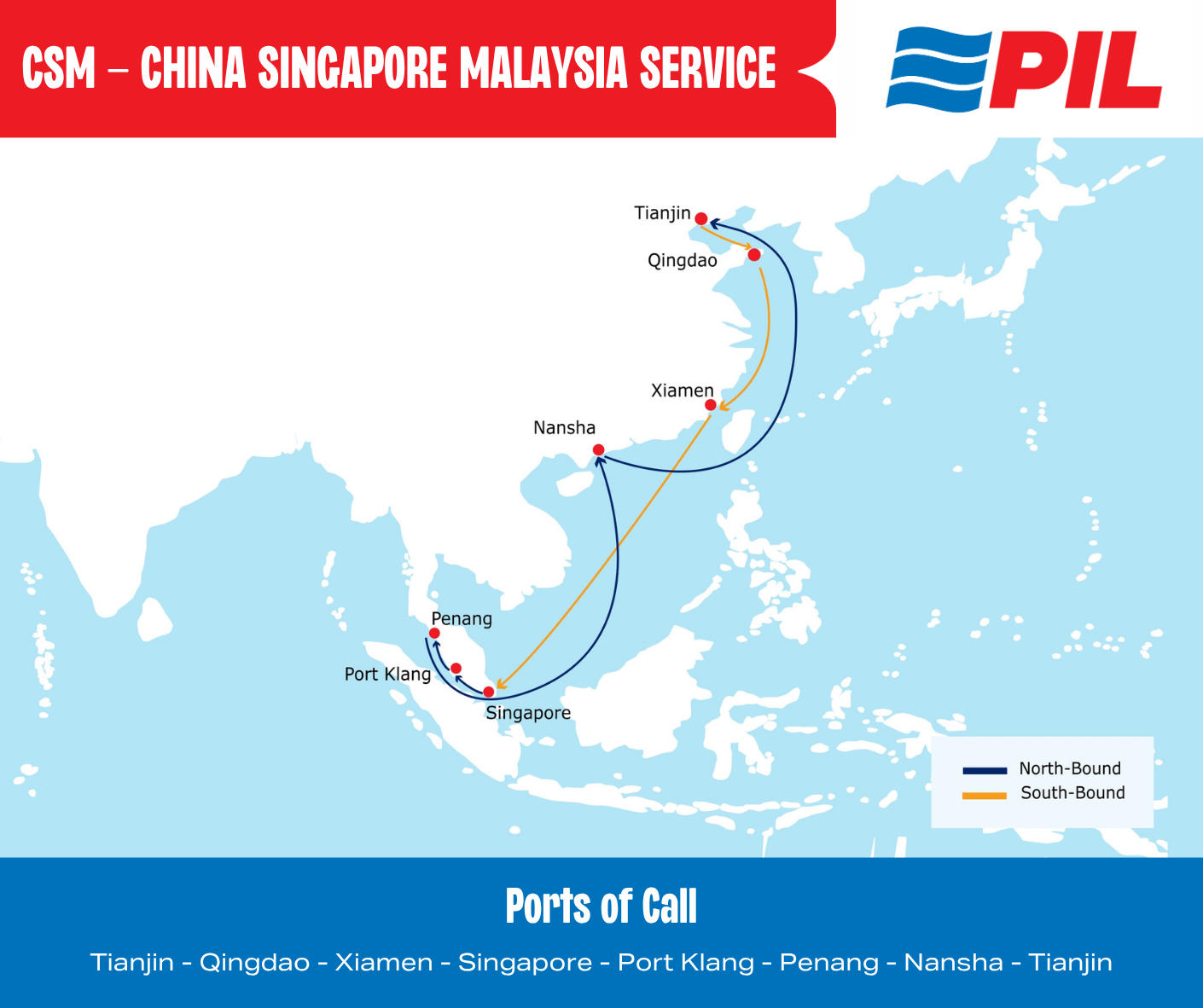
Pacific International Lines (PIL) is expanding its Intra-Asia network with two services connecting China with Indonesia, Singapore and Malaysia.
The carrier will enhance its North China
Indonesia (NCI) Service and launch a new China Singapore Malaysia (CSM)
Service.
Both services will operate weekly and support
dry and reefer cargo.
NCI connects China, Indonesia and Singapore
The enhanced North China Indonesia Service
will begin on 8 November 2026 from Qingdao.
The service will provide a direct weekly
connection between China, Indonesia and Singapore.
According to PIL, the NCI is designed to
support growing trade and reefer cargo flows between China and Indonesia.
A consortium of vessels will operate the
service.

New China Singapore Malaysia service
PIL will launch its new CSM Service from
Tianjin on 27 October 2026.
The weekly service will connect North and
South China with Singapore and key gateways in West Malaysia.
Customers will also have access to PIL’s
wider global network through transhipment connections in Singapore.

“Asia continues to be a key engine of global trade growth, and we are seeing increasing demand for efficient and reliable connectivity within the region,” said Rita Wong, General Manager, Intra-Asia Services at PIL.
She added that the two services will provide
wider port coverage and greater access to markets across China, Indonesia and
Malaysia.
PIL said the expansion will strengthen its
regional network and provide additional connections across the Intra-Asia
market.
Suez
return cuts India-Savannah transit times by up to 14 days

The return of some container services to the Suez Canal is cutting transit times between India and the Port of Savannah by as much as 10 to 14 days, according to the Georgia Ports Authority (GPA).
Several major container lines have begun
restoring selected Red Sea and Suez Canal routings after extended diversions
around the Cape of Good Hope.
GPA said the shorter voyages are improving
supply chain velocity for cargo owners. They can also support faster inventory
replenishment and reduce inventory carrying costs.
Maersk shifts MECL back to Suez
Maersk has shifted its MECL service from the
Cape of Good Hope back to the Suez Canal.
The change has reduced the transit time from
Nhava Sheva, India, to Savannah to 28 days.
The Maersk Denver made the carrier’s
first new westbound sailing through the Suez Canal, calling Savannah on 9
August. Maersk has also added an eastbound call at Jeddah, Saudi Arabia, to the
MECL service.
CMA CGM is also returning its INDAMEX service
to the Suez Canal.
According to GPA, the change will reduce
transit time from Nhava Sheva to Savannah by five days. It will also allow the
service to maintain weekly frequency with two fewer vessels.
“Georgia Ports welcomes the transit time
improvements as several major carriers return to Suez routings linking Georgia
to world markets,” said Kevin Price, President of Georgia Ports.
MSC plans further Suez returns
MSC has announced plans to restore Suez Canal
routings in both directions on four major Asia-Europe and Mediterranean
services: Tiger, Albatross, Himalaya Express and Jade.
Removing the Cape of Good Hope diversion is
expected to allow MSC to operate each service with two fewer vessels,
increasing available container ship capacity elsewhere in its network.
“We are glad to see ocean carriers resuming
Red Sea transits using the Suez Canal, the fastest and most economical way to
link Asia, South and Southeast Asia and the Middle East to the U.S. market,”
said GPA Chief Commercial Officer Flavio Batista.
He added that shorter lead times could
benefit cargo owners that have diversified manufacturing into Southeast Asia
and the Indian subcontinent.
Savannah highlights landside connections.
GPA said shorter ocean voyages are only one
part of improving overall supply chain speed.
The Port of Savannah currently handles 40
weekly vessel calls and 42 weekly double-stack trains, alongside nearly 15,000
daily truck moves.
Containers moving by rail average around 20
hours between vessel discharge and rail departure. The port’s surrounding
distribution network also provides options for transloading, inventory
positioning and order fulfilment.
CLdN
orders two new 6,700 lane-metre RoRo vessels from HD Hyundai

Large modern RoRo vessel sailing near a European port terminal, illustrating CLdN’s fleet expansion with new 6,700 lane-metre ships.
CLdN has placed an order for two new 6,700
lane-metre RoRo vessels with HD Hyundai Heavy Industries, further expanding its
shortsea shipping fleet.
Construction is scheduled to begin in early
2028, with delivery expected in mid-2029. The ships will be the 15th and 16th
vessels ordered by CLdN from the South Korean shipbuilder over the past decade.
Higher cargo capacity
The new vessels will feature an additional
deck and more ground space compared with CLdN’s existing 5,000 lane-metre class
ships.
Their configuration will be specifically
adapted for trailer cargo. CLdN said the additional capacity will complement
its existing fleet of RoRo and container vessels and its European port and
door-to-door logistics network.
The vessels will also feature wide ramps
providing immediate access to the upper decks. This is designed to accelerate
loading and unloading and improve port turnaround times.
Dual-fuel design targets greater efficiency
Both ships will be dual-fuel capable,
allowing them to operate on conventional marine diesel or LNG.
Space will also be reserved for larger
electric shaft generators and batteries, allowing the vessels to incorporate
these technologies in the future.
CLdN expects fuel consumption per vessel to
be similar to its existing 5,000 lane-metre ships. However, the higher cargo
capacity is expected to improve fuel efficiency per tonne-kilometre by between
30% and 40%.
“We are delighted to extend our partnership
with HD Hyundai Heavy Industries for the construction of these two new vessels.
The ships will expand the capacity of our existing fleet and will give us even
greater flexibility to meet customer needs,” said Florent Maes, CEO of CLdN.
Maes added that the vessels’ improved fuel
efficiency would further support CLdN’s efforts to reduce the carbon footprint
of its RoRo operations.
CLdN currently operates 30 ships and more
than 200 sailings per week, providing shortsea RoRo connections between
continental Europe, the United Kingdom, Ireland, Iberia and Scandinavia.
Hapag-Lloyd
CEO heads to Israel as revised $4.2 billion ZIM proposal takes shape

Hapag-Lloyd CEO Rolf Habben Jansen is expected to visit Israel as the German carrier and Israeli private equity fund FIMI prepare a revised proposal for their planned $4.2 billion acquisition of ZIM.
According to a report by Israeli financial
newspaper Calcalist, Habben Jansen is due to arrive in Israel on Wednesday,
ahead of a revised proposal expected to be submitted on Sunday.
The report said the buyers are preparing
significant changes to address concerns raised by Israeli authorities reviewing
the transaction.
Israeli authorities raise concerns over ZIM
routes
According to Calcalist, six of the eight
Israeli government bodies whose positions are required before the state can
approve the transfer of its golden share currently oppose the transaction.
The report identified concerns from bodies
including the Government Companies Authority, the Israel Shipping and Ports
Authority and the Ministry of Defense.
One of the main issues reportedly concerns
the international shipping network that would remain available to ZIM’s Israeli
operations following the transaction.
Under the proposed structure, Hapag-Lloyd
would acquire ZIM’s international operations, while FIMI would establish and
control a separate company, referred to as ZIM Israel, holding strategic
Israeli assets covered by the state’s golden share.
Calcalist reported that FIMI would receive 16
vessels to form the core of ZIM Israel. The report said Israeli authorities do
not object to the transfer of those vessels.
Instead, discussions are focused largely on
the number of shipping routes that would remain available to the Israeli
company.
Israel reportedly seeks six to 10 routes
According to Calcalist, the current proposal
would leave ZIM Israel with three shipping routes.
Two would serve Greece, while another would
connect with the United States.
However, citing sources familiar with the
discussions, Calcalist reported that Israeli authorities want ZIM Israel to
retain access to at least six routes and potentially as many as 10.
At least one connection with the Far East is
considered essential, according to the report.
The concern is linked to maintaining Israel’s
maritime connectivity during a regional emergency, particularly if foreign
carriers reduce or suspend services to Israeli ports.
Israeli officials also reportedly have
concerns about the financial strength of the proposed ZIM Israel entity and its
potential dependence on Hapag-Lloyd for parts of its operations.
Buyers prepare revised proposal
The Hapag-Lloyd and FIMI proposal has already
undergone changes as discussions with Israeli authorities continue.
According to Calcalist, the buyers have
agreed to tighter restrictions on foreign ownership of ZIM Israel and increased
state control over the company.
They have also committed to strengthening
shipping connections between Israel and destinations in Asia, the report said.
The transaction has already received approval
from ZIM shareholders but remains subject to the required Israeli regulatory
approvals.
The revised proposal expected on Sunday is
aimed at addressing the outstanding government concerns over maritime security,
route access and the structure of ZIM Israel.
/// Air Cargo News
///
ASL Airlines Australia adds third
737-800BCF freighter

ASL Airlines Australia is set to take delivery of its third Boeing 737-800BCF freighter, VH-AZ4, with the aircraft scheduled to arrive in Brisbane on September 19 following an approximately 18,000-kilometre ferry flight from Shannon, Ireland.
The
aircraft departed Shannon on Thursday and is routing via Sofia, New Delhi,
Kuala Lumpur, and Lombok before touching down in Brisbane. ASL Airlines
Australia credited teams across ASL Airlines Australia, ASL Group, ASL Ireland,
and Southern Cross International for coordinating the delivery, which involved
securing regulatory approvals and overflight and landing clearances across
multiple Flight Information Regions.
This
19.6-year-old aircraft previously flew passengers for Shenzhen Airlines. In
2023, it was converted into a freighter and operated by ASL Airlines Ireland
for SolitAir (registered as EI-HRB) until recently.
The
addition of VH-AZ4 marks the latest step in the carrier's freighter fleet
build-out. ASL Airlines Australia took delivery of its first 737-800BCF,
VH-CYK, in early 2024, followed by a second aircraft, MSN 28595, in August
2025, which enabled the airline to launch dedicated trans-Tasman cargo services
for FedEx between Australia and New Zealand from late September 2025.
The
Sydney Bankstown-based carrier, a subsidiary of Ireland's ASL Aviation
Holdings, has signalled further expansion plans, having disclosed intentions to
add four more 737-800BCFs to its Australia-New Zealand operation, with some
aircraft to be transferred from ASL's European fleet.
The
airline has also entered a conditional agreement to acquire the New Zealand and
Australia freight business of Airwork Group, a deal that remains subject to due
diligence and regulatory conditions.
Alongside its 737-800BCF freighters, ASL Airlines Australia, formerly Pionair, rebranded after ASL Aviation Holdings' 2023 acquisition and operates a fleet of BAe 146-200 and BAe 146-300 aircraft, and provides ACMI cargo services mainly for Qantas Freight.
SAS Scandinavia Cargo appoints Allied Aviation GSSA for India

SAS Scandinavia Cargo has appointed Allied Aviation as its General Sales and Services Agent (GSSA) for India, with the partnership taking effect from 1 October 2026. The appointment will support SAS Scandinavia Cargo’s five-weekly services between Mumbai and Copenhagen.
The
airline will operate the route with Airbus A330 aircraft, while Allied Aviation
will oversee cargo sales, shipment supervision and revenue optimisation across
the Indian market. The partnership is expected to strengthen SAS Scandinavia
Cargo’s cargo presence in India and support freight connectivity between the
country and Scandinavia through Copenhagen.
Kritika
Seth, Executive Director, Allied Aviation, said, “This is an important addition
to our airline portfolio, giving Indian exporters direct capacity into
Copenhagen and access to SAS Scandinavia Cargo’s wider network across
Scandinavia and beyond.”
Kritika
Seth, Executive Director, Allied Aviation, speaking at the Aviation Connect
Conference, Athens Allied Aviation will target a diverse range of commodities
for the Mumbai services, including high-value pharmaceuticals, perishables,
engineering goods and machinery, garments and e-commerce shipments.
Seth
said Allied’s established relationships with freight forwarders across India
will help generate demand for the new Mumbai services and support SAS
Scandinavia Cargo’s expansion in the Indian cargo market.
The
GSSA will leverage its nationwide network, with offices in Mumbai, Ahmedabad,
Hyderabad, Kolkata, Delhi, Chennai, Bengaluru, Kochi and Thiruvananthapuram, to
support cargo sales and customer engagement.
The
appointment is part of Allied Aviation’s strategy to expand its airline
representation business by combining nationwide cargo sales capabilities with
local market expertise.
Allied
Aviation is also set to participate in the TIACA Air Cargo Forum 2026 in Miami,
US, from 26–29 October. The company’s team will meet with airlines and freight
forwarding partners to discuss its expanding GSSA network and opportunities in
the Indian market.
Joby completes first autonomous US
transcontinental flight

Joby Aviation has completed what it describes as the first autonomous flight across the United States, demonstrating its autonomy technology on a converted Cessna Caravan. The aircraft covered 3,199 miles during the eastbound leg of a month-long cross-country tour, completing taxiing, take-offs, navigation and landings without any control inputs from the onboard safety pilot.
The
flight was conducted under remote supervision from Joby’s Autonomy Headquarters
in California and Shaw Air Force Base in South Carolina, located up to 2,323
miles from the aircraft. The demonstration highlighted the potential use of
autonomous aircraft for commercial freight, medical transport, disaster
response and defence logistics.
By
integrating its autonomous system with an already-certified aircraft, Joby said
the approach could provide a scalable pathway for autonomous air logistics.
During the journey, the aircraft operated in high-density environments,
including Phoenix Deer Valley, one of the busiest general aviation airports in
the US.
It
also demonstrated the ability to reroute around severe weather and
thunderstorms in real time without prior familiarity with the airports
involved.
The
aircraft completed the eastbound journey in North Carolina’s Outer Banks, near
the site of the Wright brothers’ first powered flight. JoeBen Bevirt, Founder
and CEO of Joby Aviation, said, “This journey across America offers a glimpse
into a new era of aviation.
Autonomy
has an important role to play in the future of flight, allowing us to connect
remote communities, deliver critical supplies, respond faster to disasters,
support military operations, and keep pilots out of harm’s way.”
Proven
operational track record Joby’s autonomous technology has completed more than
400 flights and 800 hours of automated flight operations across controlled and
uncontrolled airspace. The system builds on the autonomy technology acquired
from Xwing in 2024 and has also been tested during three major US military
exercises.
During
the Air Force’s Agile Flag exercise, the technology delivered critical
replacement parts 24 hours faster than conventional logistics, while during
REFORPAC, aircraft operating in Hawaii were remotely controlled from Guam,
nearly 4,000 miles away.
Following
the completion of the eastbound journey, the aircraft will begin its return
westbound route, with planned stops in Raleigh, Fredericksburg/Washington,
D.C., Louisville, Wichita, Oklahoma City, Salt Lake City and Portland.
California-based
Joby Aviation is an aviation company developing aircraft, propulsion and
autonomous flight technologies for commercial and defence applications. The
company also operates Blade, an urban air mobility business providing passenger
transportation services in the US and Europe.
Afcom signs aviation fuel supply deal
with HPCL

Afcom Holdings has signed a long-term Aviation Fuel Supply Agreement with Hindustan Petroleum Corporation Limited (HPCL), covering the supply of Jet A-1 aviation turbine fuel across HPCL’s pan-India aviation fuelling network. The agreement, effective from September 1, 2026, is structured on IATA Model Terms and supported by a Location Agreement covering HPCL’s aviation fuel network in India.
It
will provide Afcom with a secured and competitively priced supply of aviation
turbine fuel. The agreement was executed by Deepak Parasuraman, Chairman and
Managing Director, Afcom Holdings, and Amit Tandon, General Manager (Aviation),
HPCL. Under the agreement, HPCL will supply Jet A-1 fuel to support Afcom’s
operational requirements across its aviation fuelling network in India.
The
partnership also provides quality assurance as per IS 1571:2008, streamlined
coordination through a single supply framework and operational flexibility to
support Afcom’s current and future network requirements.
Commenting
on the development, Parasuraman said the long-term partnership with HPCL would
provide Afcom with reliable fuel access, quality assurance and operational
support as it expands its cargo network. Sibi Mathew, Executive Director (Aviation),
HPCL, said the company was pleased to partner with Afcom Holdings as it
strengthens its presence in India’s growing cargo aviation segment.
He
added that HPCL would support Afcom’s growth across its airport network through
its nationwide aviation fuel infrastructure and quality systems. The fuel
agreement comes as Afcom continues to expand its freighter operations. The
company currently operates three Boeing 737-800 converted freighters and plans
to increase its fleet to five aircraft by the end of 2026. Its international
network covers Southeast Asia, the Maldives and the UAE, while it also operates
domestic charter services.
Afcom
has also been pursuing further international expansion. In September, the
company executed a letter of intent with Boeing for the purchase of up to four
777-8F freighter aircraft. The LOI is subject to the finalisation of definitive
documentation between the two parties. The planned aircraft are intended to
support the expansion of Afcom’s network into the Far East and Africa.
The
company’s expansion has followed a period of financial growth. Afcom reported
an 86% year-on-year increase in profit after tax to ₹392.4 million in the first
quarter of FY2026-27, while revenue from operations rose 48% to ₹1.761 billion.
The
quarter ended June 30, 2026. During the quarter, Afcom also operated the first
cargo flight at Noida International Airport with a Boeing 737-800 freighter on
the Chennai-Noida-Chennai route, carrying around 20 tonnes of mixed cargo. In
August, it shifted its freighter operations from Mumbai to Navi Mumbai International
Airport and began three weekly services from Navi Mumbai to Dubai World
Central.
Afcom
received its air operator certificate in December 2024 and launched cargo
services on the Chennai-Bangkok route later that month. The company currently
operates Boeing 737-800 freighters connecting Chennai with regional markets
including Bangkok, Colombo and Malé.
Kochat
Narendran, who served as President of Afcom Holdings, stepped down from the
role in September 2026, after nearly six years with the company. He joined
Afcom in January 2020, when the company was developing plans to launch a cargo
airline from Chennai.
Established in 2013, Afcom Holdings provides airport-to-airport cargo transport services across domestic and international markets, including ASEAN and Middle Eastern countries. HPCL is a Government of India Maharatna CPSE and its aviation business serves Indian and international airlines, business aviation, defence and general aviation customers across India’s airport network.
Cathay Cargo Named
Cargo Operator of the Year Again

Cathay Cargo has once again been named Cargo Operator of the Year, reinforcing its position in the global air freight market and recognising its performance in cargo operations and customer service.
The
award highlights the carrier’s continued focus on reliable cargo
transportation, network connectivity and specialised logistics solutions.
Cathay Cargo operates an extensive international freighter and belly-cargo
network through its Hong Kong hub, connecting Asia with key markets across
Europe, North America and other regions.
The
carrier has continued to invest in digital cargo solutions and specialised
handling capabilities to meet changing requirements across industries. Its
portfolio includes solutions for pharmaceuticals, perishables, live animals and
other time sensitive or high value shipments.
The
award underscores Cathay Pacific Cargo’s continued emphasis on operational
performance and its role in supporting global supply chains through its Hong
Kong based air cargo network.
I hope you have enjoyed reading the above
news letter.
Robert Sands
Joint Managing Director
Jupiter Sea & Air Services Pvt Ltd
Casa Blanca, 3rd Floor
11, Casa Major Road, Egmore
Chennai – 600 008. India.
GST Number : 33AAACJ2686E1ZS.
Tel : + 91 44 2819 0171 / 3734 / 4041
Fax : + 91 44 2819 0735
Mobile : + 91 98407 85202
E-mail : robert.sands@jupiterseaair.co.in
Website : www.jupiterseaair.com 1Branches : Chennai, Bangalore,
Mumbai, Coimbatore, Tirupur and Tuticorin.
Associate Offices : New Delhi, Kolkatta, Cochin &
Hyderabad.
Thanks to : Container News, Indian Seatrade, Cargo Forwarder Global & Air Cargo News.


Comments
Post a Comment