
JUPITER SEA & AIR SERVICES PVT. LTD, EGMORE – CHENNAI, INDIA.
E-MAIL : Robert.sands@jupiterseaair.co.in Mobile : +91 98407 85202
Corporate News
Letter for Wednesday November 04, 2026
Today’s
Exchange Rates
|
Currency ▲ |
Price |
Change |
%Change |
Open |
Prev.Close |
Day's Low-High |
|
94.95 |
-0.310005 |
-0.325431 |
95.21 |
95.26 |
94.925 - 95.2875 |
|
|
1.1153 |
-0.0027 |
-0.2415 |
1.118 |
1.118 |
1.1137 - 1.1215 |
|
|
127.512 |
0.704903 |
0.555886 |
127.5179 |
126.8071 |
127.3226 - 127.6426 |
|
|
106.332 |
0.263298 |
0.248233 |
106.5672 |
106.0687 |
106.2455 - 106.6299 |
|
|
157.296 |
-0.414001 |
-0.262508 |
157.71 |
157.71 |
156.963 - 157.898 |
|
|
1.3391 |
0.0015 |
0.112142 |
1.3377 |
1.3376 |
1.3374 - 1.3434 |
|
|
0.6036 |
0.0008 |
0.132716 |
0.6041 |
0.6028 |
0.6029 - 0.6063 |
/// Sea Cargo News ///
Maersk
schedules first India drydocking
Maersk will undertake its first planned drydocking in India, with the container vessel Maersk Chattogram scheduled to enter L&T Shipbuilding’s Kattupalli Shipyard near Chennai.
The Singapore-flagged vessel is expected to
arrive at the shipyard on 20 October 2026, subject to operational and weather
conditions.
The project represents the first operational
milestone under the Memorandum of Understanding signed by Maersk and Larsen
& Toubro during India Maritime Week 2025.
The agreement established a framework for
cooperation covering shipbuilding, vessel repair and the exchange of knowledge
relating to international maritime standards and shipyard capabilities.
Maersk Chattogram to undergo special survey
The scheduled drydocking forms part of Maersk
Chattogram’s normal lifecycle maintenance programme.
Work will include the vessel’s special
survey, together with inspection, maintenance and overhaul activities covering
its hull, structure, machinery, equipment and propulsion systems.
L&T Shipbuilding will use its Shiplift
system at Kattupalli, described by the companies as the largest in India, to
lift the vessel clear of the water.
“The drydocking of Maersk Chattogram in India
is a meaningful step towards turning our collaboration with L&T into
action,” said Dinesh Kumar Balraj, Head of Fleet Operations East at Maersk.
“We are aligning Maersk’s global technical
requirements with India’s growing shipyard, supplier and maritime-service
capabilities,” he added.
Project brings together Indian maritime
suppliers
The project will involve Maersk’s fleet and
technical teams, L&T personnel, Indian subcontractors, suppliers and
maritime service providers.
The partners will focus on safety, execution,
quality and the exchange of operational knowledge during the drydocking.
“The docking of Maersk Chattogram at
Kattupalli advances our strategic partnership under the MoU and Framework
Agreement signed between our organisations,” said Arun Ramchandani, Head of
Precision Engineering & Systems at L&T.
“Combining Maersk’s global maritime expertise
with L&T’s shipbuilding capabilities, we aim to strengthen domestic
capabilities and supply chains across the shipbuilding ecosystem,” he noted.
The project moves the Maersk–L&T
partnership from an exploratory framework to its first vessel-maintenance
operation in India.
SLPA plans
new Colombo logistics hub under PPP model

The Sri Lanka Ports Authority (SLPA) has decided to develop a new logistics hub within the Port of Colombo under a Public–Private Partnership model.
The authority will pursue the project through
a competitive bidding process, subject to the necessary approvals.
The decision follows the discontinuation of
the previously proposed South Asia Commercial and Logistics Hub project.
Previous joint venture discontinued
The South Asia Commercial and Logistics Hub
was established in 2023 with the participation of China Merchants Port Holdings
Company Limited, SLPA and Access Engineering PLC.
The project envisaged an investment of
approximately US$280 million for the development of a modern logistics facility
covering around 150,000 square metres.
Following an assessment of external
circumstances, commercial considerations and shareholder interests, the
participating parties decided not to proceed with the project.
The shareholders will receive refunds of
their respective equity contributions, totalling approximately US$29.8 million.
The refunds remain subject to applicable regulatory requirements and
operational expenses.
Competitive process planned
SLPA will now pursue an alternative
development strategy through a competitive bidding process.
The proposed integrated logistics hub will
aim to expand the Port of Colombo’s capabilities beyond container
transshipment. It will support a wider range of port-related and value-added
logistics services.
According to SLPA, the development is
expected to attract private-sector investment and improve the use of port land
and infrastructure.
The authority also expects the project to
generate sustainable long-term revenue and strengthen Colombo’s position as a
leading maritime and logistics hub in South Asia.
Project
Cargo East of Suez: Routing Oversized Freight When the Short Way Is Not Simple

Since late 2023, attacks on merchant shipping around the southern Red Sea have changed how many carriers route between Asia, the Red Sea, the Gulf and East Africa. Much of the public discussion has focused on standard containers and headline freight rates.
For shippers of project and oversized cargo,
such as machinery, generators, steel structures and plant modules, the change
has been more awkward. Their cargo depends on special equipment, careful
planning and fewer options.
This piece does not try to predict when
conditions will change. It sets out the practical questions we now work through
on every out-of-gauge file headed to these regions.
Suez or the Cape: a decision made shipment by
shipment
For cargo moving between Asia and Europe or
the Mediterranean, many carriers have chosen the Cape of Good Hope over the
Suez Canal. That adds sailing time and changes port rotations. For cargo whose
destination is itself on the Red Sea, such as Jeddah, Port Sudan, Aqaba or
Hodeidah, sailing around the Cape is not the answer. The question becomes which
carriers still call, how they call, and through which hub.
This means routing decisions are made
shipment by shipment rather than lane by lane. A routing that worked last
quarter may not be offered now, and the same carrier may treat different
destination ports differently. For oversized cargo, which often has a fixed
site date and limited equipment, a quote should state the actual routing and
carrier. A generic transit time is not enough.
Hub switching and the extra handling it
brings
When direct calls are withdrawn, cargo is
often moved through a transhipment hub and then a feeder or regional service.
For standard boxes, that mostly means extra time. For project cargo, every
extra lift is a risk. A flat rack carrying an over-width unit must be handled,
stowed and lashed correctly at each terminal. Not every hub or feeder vessel is
equally suited to out-of-gauge units.
Before booking, we ask three things. Will the
hub accept the unit’s dimensions and weight? Can the connecting vessel stow it
on or under deck as needed? How long is the unit likely to wait for a
connection? A switch of hub after booking can mean a new acceptance process, so
it pays to confirm acceptance with the carrier for the full routing, not only
the first leg.
Flat racks and open tops: equipment is part of the plan
Special equipment is not evenly distributed. Flat racks and open-top containers
have to be positioned where the cargo is. When services change, empty special
equipment can end up in the wrong place. Shippers should ask early whether the
required equipment is available at the loading port for the intended sailing,
and plan production around it.
When out-of-gauge acceptance on container
services is limited, breakbulk or a combination of containers and breakbulk
becomes a real option. For some units, conventional vessels or multipurpose
ships offer a more direct route to the destination than a container network
that has been redesigned around the disruption. The right answer depends on
dimensions, weight, destination port facilities and timing.
War-risk insurance and surcharges
Carriers may apply war-risk or emergency
surcharges on affected lanes, and marine insurers may apply additional premiums
for voyages through listed areas. These can change at short notice. Shippers
should check three things.
Does the freight quote include or exclude
these surcharges? Does the cargo insurance policy cover the actual routing, including
any listed areas? Who under the agreed Incoterm bears the cost if surcharges
are introduced after booking? Agreeing this clearly in the sales contract
avoids disputes later.
Documents: small errors, large delays
Rerouting and transhipment add places where
documents can cause trouble. Bills of lading must reflect the actual port of
discharge and any agreed place of delivery. For project cargo, packing lists
should give accurate dimensions and weights for every piece, together with
lifting points and centre-of-gravity details where relevant.
Several destinations in the Red Sea, Gulf and
East Africa have their own import documentation, pre-shipment certification or
registration requirements. These should be confirmed with the consignee and
destination agent before the cargo leaves origin, not after it arrives.
What shippers can do now
The common thread is to plan earlier and in
more detail. In practice, that means:
– Get routing and carrier details in writing for the specific destination port.
– Confirm out-of-gauge acceptance for every leg, including the hub.
– Check special equipment availability before fixing production dates.
– Compare container and breakbulk options for oversized units.
– Clarify war-risk surcharges and insurance cover against the actual routing.
-Confirm destination document requirements before shipment.
Conditions on these lanes may continue to
shift, and I will not try to say how or when. What does not change is that
project cargo rewards careful preparation. Shippers who ask these questions
early keep more options open when routings move.
About the author :
Delia Qu is Deputy General Manager at Dalian
Yihang Shipping Agency Co., Ltd., a Class-1 international freight forwarder,
NVOCC and AEO Advanced Certified customs broker in Dalian, China. She has more
than ten years of experience in freight forwarding. Founded in 2020, the
company handles ocean FCL and LCL, air freight, China–Europe rail, project and
breakbulk cargo, and exhibition cargo to more than 80 countries through 180+
overseas agents.
AD Ports
Group reports reduction in emissions intensity in 2025

AD Ports Group has released its 2025 Sustainability Report, highlighting significant progress in its decarbonisation journey as the business continued its global expansion.
Total emissions intensity, measured in tonnes
of CO2 equivalent per AE$ 1 million in revenue across Scopes 1, 2 and 3, fell
6% to 190.68 tCO2e from 203.06 tCO2e in 2024, demonstrating progress in
decoupling emissions from business growth during a year in which Group revenue
rose 20 percent to AED 20.77 billion.
Total absolute emissions across the Group’s
own activities and its full value chain rose 13% to 3,957,755 tCO2e, a rate
less than the 20% revenue growth.
The Maritime and Shipping Cluster, which
generated 51% of Group revenue, accounted for 50% of Group emissions, followed
by Ports at 24 percent, Logistics at 21% and Economic Cities and Free Zones at
5 percent.
The Group also purchased 47,960 MWh of
renewable energy certificates and diverted 10,303 tonnes of waste in 2025, a 24
percent increase on 2024.
In 2025, AD Ports Group adopted a
decarbonisation pathway covering its operations and value chain, with 139
initiatives planned between 2025 and 2050, aligned with the Paris Agreement’s
2°C goal and the UAE Net Zero 2050 strategic initiative.
The pathway is backed by a projected USD 636
million investment over 25 years targeting a cumulative reduction of 2.9
million tCO2e.
Specific 2025 initiatives included
LNG-powered Pure Car and Truck Carrier vessels in the United Global Ro-Ro
venture, ship-to-ship LNG bunkering and the launch of plans with Nimex
Terminals to develop LNG and LPG terminal hubs at Khalifa Port.
Executive compensation of senior management
is linked in part to the achievement of sustainability targets.
Captain Saif Al Mheiri, Abu Dhabi Maritime
CEO and Group Chief Sustainability and Risk Officer, described defining a net
zero pathway across a business of AD Ports Group’s scale as a significant
achievement, expressing conviction that sustainable growth is achievable at
scale through the embedding of decarbonisation into corporate strategy and
decision-making.
SC Ports
handles first Isuzu container shipment through Inland Port Greer

South Carolina Ports (SC Ports) has handled the first container carrying production equipment for Isuzu North America Corporation’s new manufacturing facility in South Carolina.
The shipment arrived at the Port of
Charleston before moving by rail to Inland Port Greer. It marks an early
logistics milestone for Isuzu’s planned production operations in Greenville
County.
Isuzu selected the location in 2025, partly
because of its rail connection to the Port of Charleston. The company expects
to begin production at the new facility in 2027.
The plant will manufacture N-Series Gas,
N-Series Electric and F-Series Diesel trucks.
Inland Port Greer supports automotive supply
chains
Inland Port Greer provides rail connections
between the Port of Charleston and industrial customers across the southeastern
United States.
The facility operates along the Interstate 85
corridor between Atlanta and Charlotte. It offers overnight rail service
through Norfolk Southern six days a week, alongside 24-hour gate access.
SC Ports completed a $55 million expansion of
the inland port in 2025. The project added 9,000 feet of rail infrastructure
and increased cargo handling capacity by 50%.
Following the expansion, the terminal can
accommodate up to 300,000 rail lifts annually.
“Having a reliable and efficient supply chain
is critical to our long-term success as we establish production operations in
South Carolina,” said Yoshi Murakami, Chairman and CEO of Isuzu.

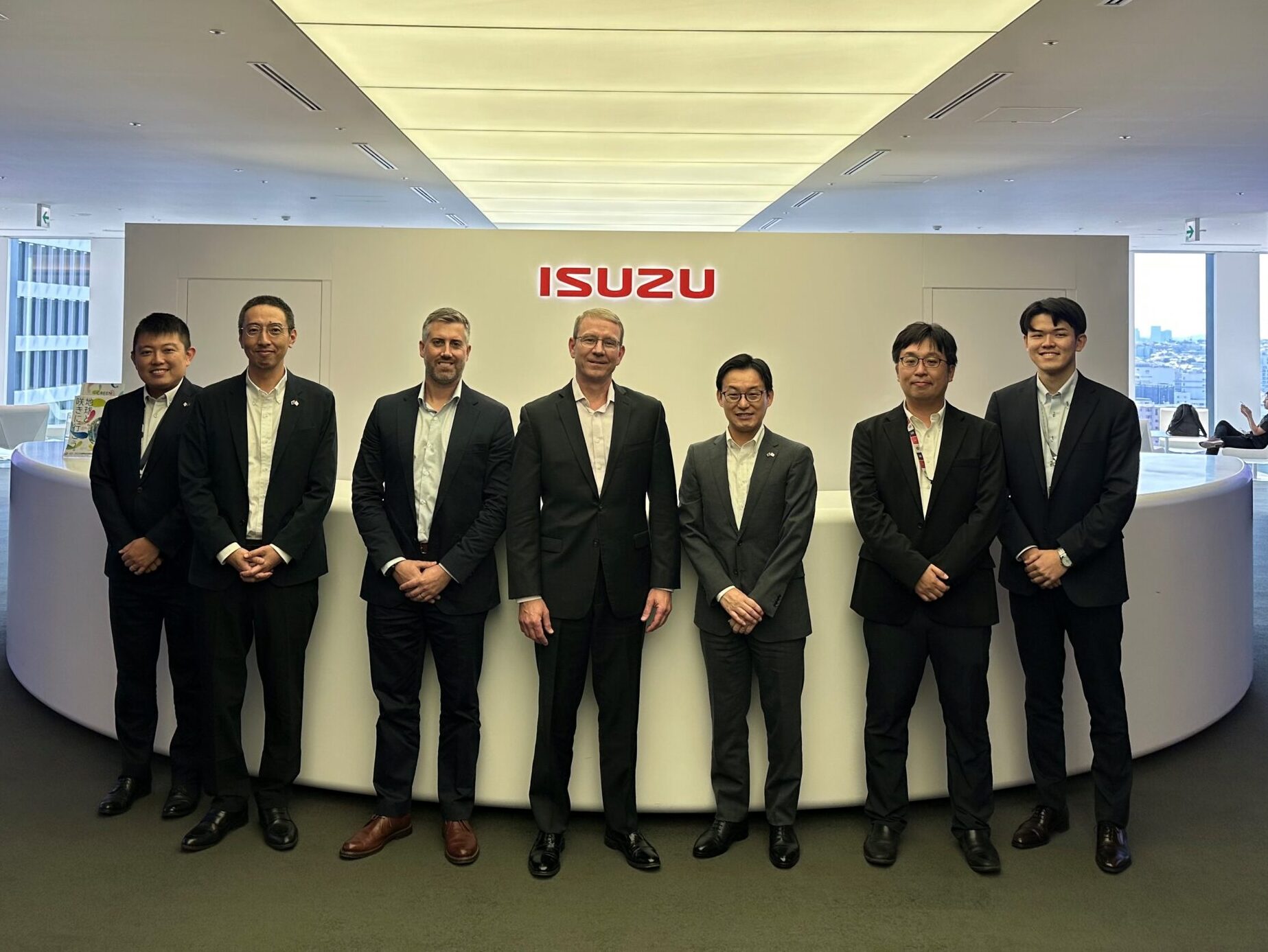
SC Ports Director of Vessel Operations & Carrier Sales Tom Boyle, and Chief Commercial Officer Byron Miller recently traveled to Isuzu Global Headquarters in Yokohama, Japan. (Photo/SC Ports)
Charleston strengthens automotive logistics
connections
The first shipment highlights the role of the
Charleston–Greer rail connection in supporting automotive manufacturing
investments.
According to SC Ports, its facilities handle
approximately 10% of containerised automotive cargo volumes in the United
States, based on PIERS data.
The port authority also reported that Inland
Port Greer experienced 355% growth during its first decade of operations.
SC Ports President and CEO Micah Mallace
welcomed the Isuzu shipment and highlighted the inland port’s role in
supporting industrial supply chains.
The latest delivery represents the arrival of
production equipment rather than the start of regular component shipments.
Isuzu’s manufacturing operations are scheduled to begin in 2027.
COSCO
Shipping Ports: What is driving its overseas terminal growth?

COSCO Shipping Ports’ overseas terminal portfolio is outperforming its wider network in 2026, although the headline figures conceal significant differences between individual facilities.
According to the
latest throughput figures reported by Container News, the company’s overseas terminals, excluding Container
Terminal Tollerort (CTT), handled 31.48 million TEUs during January–September,
an increase of 18.9% year on year.
This compares with 8.5% growth across the
company’s reported monthly throughput portfolio, which reached 93.91 million
TEUs over the same period. Overseas terminals also recorded a 20.7% increase in
September alone.
The figures indicate that international
operations are contributing significantly to the group’s expansion. However,
strong gains at some facilities contrast with substantial declines elsewhere,
making terminal-level performance essential to understanding the broader trend.
Suez leads in volume, Chancay in percentage
growth
The company’s
official monthly throughput statistics reveal
sharply contrasting performances across its international portfolio.
|
Terminal |
Jan–Sep 2026 |
YoY change |
|
Suez Canal Container Terminal |
4.70 million TEUs |
+17.3% |
|
Piraeus Container Terminal |
3.09 million TEUs |
+1.7% |
|
Euromax Terminal Rotterdam |
1.66 million TEUs |
−5.5% |
|
CSP Abu Dhabi Terminal |
540,700 TEUs |
−55.3% |
|
CSP Chancay Terminal |
341,400 TEUs |
+47.3% |
Source: COSCO Shipping Ports, monthly
throughput statistics, September 2026.
Chancay recorded the fastest percentage
growth among these facilities, with throughput increasing 47.3% during the
nine-month period. However, its relatively small volume base limits its
contribution to the portfolio’s overall expansion.
Suez presents a different picture. Its 17.3%
growth was recorded on a much larger operational base, representing
approximately 693,000 additional TEUs compared with the corresponding period of
2025.
By comparison, Chancay’s increase amounted to
approximately 110,000 TEUs.
This distinction is important: percentage
growth highlights momentum, while absolute volume changes provide a clearer
indication of which terminals contribute most to overall expansion.
Piraeus recorded a comparatively modest 1.7%
increase over nine months, despite stronger September growth of 15.3%. The
latest monthly improvement is notable, but further data will be needed to
determine whether it represents a sustained trend.
Abu Dhabi exposes the uneven performance
The most significant negative development
among the selected facilities comes from CSP Abu Dhabi Terminal.
Throughput declined 55.3% to approximately
541,000 TEUs during January–September, compared with around 1.21 million TEUs
in the corresponding period of 2025.
This represents a reduction of approximately
670,000 TEUs, almost equivalent to the additional volume recorded at Suez over
the same period.
The decline is particularly relevant because
it illustrates how individual terminals can move in sharply different
directions despite strong overall portfolio growth.
In its first-half
results, reported by Container News, COSCO
Shipping Ports attributed Abu Dhabi’s weaker performance to geopolitical
tensions in the Middle East.
The latest statistics show that the
terminal’s cumulative decline deepened from 44.3% at the end of June to 55.3%
by September.
Euromax Terminal Rotterdam also recorded
weaker activity, with throughput falling 5.5% during the nine months.
These contrasting performances highlight the
importance of assessing overseas expansion at the individual terminal level,
rather than assuming that strong portfolio growth reflects consistent
conditions across all markets.
Does higher throughput mean higher
profitability?
The company’s financial results provide
another perspective on its operational development.
According to COSCO
Shipping Ports’ official 2026 interim results,
revenue increased 12.3% to US$905.3 million during the first half of the year.
Profit though, attributable to equity holders rose 28.5% to US$233.7 million.
Gross profit increased 9.3% to US$239.5
million, although the gross profit margin declined from approximately 27.2% to
26.5%.
The figures demonstrate why throughput growth
and financial performance should be assessed separately.
COSCO Shipping Ports operates through a
combination of controlling and non-controlling interests. Consequently, an
increase in total containers handled does not necessarily translate
proportionately into consolidated revenue or profit attributable to shareholders.
The first-half results also reported a 7%
increase in equity throughput to 24.49 million TEUs.
However, these financial results cover
January–June, whereas the latest terminal-level throughput statistics extend
through September. They therefore cannot establish how much of the subsequent
overseas growth has contributed to earnings.
There is also a reporting distinction between
the company’s interim results and its monthly throughput statistics. The
monthly dataset excludes QPI and CTT, resulting in a different reporting scope.
Consequently, the two sets of aggregate throughput figures should not be
combined when calculating quarterly changes.
What the figures reveal about COSCO’s
international portfolio
The latest results show that overseas growth
is neither uniform nor driven by a single terminal.
Suez contributes substantial additional
volumes and Chancay continues expanding from a smaller base. Piraeus has
recorded stronger recent monthly performance despite limited cumulative growth.
At the same time, Abu Dhabi and Euromax
demonstrate that significant declines can occur within an otherwise expanding
international portfolio.
For COSCO Shipping Ports, the commercial
challenge is to convert this uneven operating performance into sustainable
financial returns across terminals with different ownership structures, market
conditions and growth prospects.
Subsequent financial disclosures will provide
a clearer indication of whether stronger international throughput is
translating into improved profitability.
COSCO’s overseas expansion is gaining
momentum. But the more revealing measure is where additional containers are
being handled, where volumes are being lost and how those differences affect
the group’s financial performance.
/// Air Cargo News
///
Edmonton airport breaks ground on
50,000-sq-ft cargo facility

The new facility will expand airside cargo capacity at YEG, handling time-sensitive shipments and supporting the growth of Edmonton’s International Cargo Hub. BySTAT Times|16 Oct 2026 3:20 PM Edmonton International Airport (YEG) and Terracap Management have broken ground on a new 50,000-square-foot airside cargo facility in Canada, aimed at expanding the airport’s cargo handling capacity and supporting the growth of its logistics ecosystem.
Developed,
owned and managed by Terracap, the facility will be located directly alongside
Apron VIII, enabling the efficient movement of cargo between freighter aircraft
and the warehouse. It is designed to handle time-sensitive shipments, including
e-commerce, perishables, pharmaceuticals and aviation parts.
The
project represents private-sector investment following public funding for
transportation infrastructure. The Government of Canada has committed $118
million through the National Trade Corridors Fund towards the development of
YEG’s International Cargo Hub (ICH) and associated infrastructure.
Spanning
more than 2,000 acres of serviced development land, the ICH is intended to
accommodate future cargo, logistics and trade-related projects. Terracap’s new
facility is expected to complement the broader development and support the
airport’s expanding role as a cargo and logistics hub. Myron Keehn, President
& CEO, Edmonton Airports, said, “Today’s groundbreaking is a great example
of what happens when public investment creates the conditions for private
investment.
The
International Cargo Hub is helping establish the infrastructure and
connectivity needed to support long-term cargo growth at YEG, and we’re now
seeing private-sector partners like Terracap respond with investments of their
own. This facility will add new airside cargo capacity and strengthen the
ecosystem we’re building here at Edmonton International Airport.”
Terracap
currently operates approximately 100,000 square feet of airside cargo space at
YEG, which is fully leased to major cargo operators, including Air Canada,
Cargojet, DHL and Purolator. Larry Krauss, Chief Executive Officer, Terracap
Management, said, “Terracap Management is proud to partner once again with
Edmonton International Airport on our third air cargo distribution facility.
This
new 50,000-square-foot building will provide tenants with efficient air cargo
handling and distribution, connecting Edmonton businesses to markets across
Canada and around the world. This investment reflects our continued confidence
in Edmonton and YEG’s growing importance as a major North American air cargo
and logistics hub.
We
are delighted to expand our longstanding partnership with the Airport Authority
and contribute to Edmonton’s economic growth.” Matt Jeneroux, Member of
Parliament, Edmonton – Riverbend, said, “When the federal government invests in
infrastructure that connects our businesses to the world, it helps create the
conditions for private investment to follow.
Terracap’s
new cargo facility is a great example of how these partnerships can strengthen
Edmonton’s role in global trade, support economic growth, and create new
opportunities for Albertans.” Headquartered in Toronto, Ontario, Terracap is a
private equity real estate group with a portfolio valued at $2.4 billion.
Founded in 1989, the company’s holdings span multi-residential properties,
development land, retail, office, industrial and hotel assets.
LATAM Cargo introduces VR training for
550 staff at Miami hub

The programme includes training for 250 forklift operators and uses simulated warehouse scenarios to improve hazard identification and emergency response. BySTAT Times|16 Oct 2026 12:22 PM LATAM Cargo Group has introduced virtual reality (VR) training for warehouse personnel at its Miami hub to improve operational safety, with the initial phase covering approximately 550 employees, including 250 forklift operators.
The
programme uses simulators that replicate the company's ground infrastructure,
allowing employees to practise operational procedures and respond to real-time
scenarios in a controlled digital environment. The custom-designed simulators
were developed in collaboration with Academia LATAM, LATAM Group's internal
training arm.
They
feature scenarios covering six warehouse pedestrian zones and three specialised
modules for forklift drivers. The training covers high-risk procedures,
including dangerous goods segregation, cargo handling, pedestrian traffic flow
and machinery separation protocols. It also measures employees' responses to
contingencies, including response times and their ability to identify and
mitigate hazards.
According
to the company, the immersive training is designed to improve employees'
situational awareness and bridge the gap between theoretical training and field
operations. The Miami launch follows an initial rollout of VR-based onboarding
training at the Fast Air warehouse in Santiago.
The
latest deployment expands the programme to cover a broader range of operational
scenarios. LATAM Cargo is assessing the possibility of expanding the VR
training system to other strategic hubs across its network, including Brazil.
"Integrating Virtual Reality at our Miami hub marks a key step in our
operational safety strategy.
By
placing our teams in critical operational scenarios within an exact replica of
their daily work environment, we significantly close the gap between classroom
theory and ramp practice. This directly translates into safer and more
efficient cargo handling for our customers," said Daniel Leng, Chief
Operating Officer at LATAM Cargo.
Milwaukee Airport completes new air
cargo centre

Milwaukee Mitchell International Airport completes a 337,000-square-foot cargo facility designed to accommodate five Boeing 747-400 aircraft and boost regional freight capacity. BySTAT Times|15 Oct 2026 6:41 PM Milwaukee Mitchell International Airport (MKE) has completed construction of a new air cargo centre in partnership with real estate developer Crow Holdings, expanding cargo handling capabilities and supporting regional economic growth.
The
337,000-square-foot facility is located at the MKE Regional Business Park on
the former site of the 440th Airlift Wing. It is designed to accommodate five
Boeing 747-400 aircraft simultaneously, providing additional capacity for cargo
operations.
The
facility aims to offer businesses an alternative to shipping goods through
congested airports in Illinois, potentially helping reduce delays and transport
costs for companies across Wisconsin and the surrounding region. Construction
began in February 2025 following several years of planning and collaboration
between the airport and Crow Holdings.
Investment
to support regional cargo growth The project is expected to generate more than
$1.3 million annually in aircraft landing fees and over $1 million in annual
ground lease rents and fees.
It
is also expected to support job creation, attract new businesses and strengthen
southeastern Wisconsin’s role in air cargo logistics. Airport Director Brian
Dranzik said the project transforms underutilised airport property into an
asset for Wisconsin businesses and positions MKE to play a larger role in
freight transportation.
Jack
Rabenn, Managing Director at Crow Holdings, said the project had taken more
than five years to reach completion. He added that outreach to potential users
had continued during construction and was expected to increase now that the
facility was ready for stakeholders to assess. Public-Private Partnership The
Air Cargo Centre was developed through a public-private partnership between
Milwaukee Mitchell International Airport and Crow Holdings.
With
construction complete, the airport aims to expand cargo operations and better
serve Wisconsin’s manufacturers, suppliers and other businesses moving goods
across domestic and international markets. The development forms part of MKE’s
wider effort to support transportation infrastructure and long-term economic
growth across southeastern Wisconsin.
Aramex expands presence in Gujarat with
new centre in Ahmedabad

The Ahmedabad expansion is part of Aramex's broader India strategy to support businesses across key markets and meet their growing logistics requirements. BySTAT Times|15 Oct 2026 6:15 PM (L-R) Regional CEO of GCCI Abbas Panju, India MD Veena Bhogaonkar, Group CEO Amadou Diallo, CFO Nicolas Sibuet, and CCO Faysal ElHajjami of Aramex.
Aramex
has strengthened its presence in Gujarat with a new Ahmedabad office. The
expansion will enable Aramex to provide enhanced logistics support to
businesses across the state and help them manage shipping more efficiently.
Gujarat
is one of India's key industrial and export-oriented states, with a strong
presence across sectors including textiles, pharmaceuticals, chemicals,
engineering and manufacturing, among other export-driven industries. With
Ahmedabad as a key commercial centre, Aramex's expanded presence in the city
will give businesses access to reliable logistics solutions and support the
movement of goods across domestic and international markets, particularly in
the GCC, Africa, and Europe.
The
Ahmedabad expansion is part of Aramex's broader India strategy to support
businesses across key markets and meet their growing logistics requirements.
Through its global network and cross-border logistics expertise, Aramex will
support Gujarat-based businesses with solutions across imports and exports,
warehousing, freight, express shipments, contract logistics and customised
capability-building.
As
part of its immediate priorities in the state, Aramex plans to partner with
businesses and implement its Accelerate 5X strategy, focused on growth in key
markets and strengthening trade corridors to connect businesses in the state
with international markets.
The
expansion will particularly support MSMEs and growing businesses looking to
expand beyond domestic markets and reach customers and partners
internationally. With Gujarat's strong manufacturing and export ecosystem,
Aramex aims to help businesses simplify cross-border shipments and navigate
international logistics requirements more efficiently.
Commenting
on the expansion, Veena Bhogaonkar, Managing Director, Aramex India, said,
“Gujarat is one of India’s key business and export hubs, and Ahmedabad’s strong
commercial ecosystem presents significant opportunities for Aramex to support
businesses with cross-border logistics.
With
our presence in Ahmedabad, we aim to be closer to businesses across the state
and provide them with reliable logistics solutions. As more MSMEs and
enterprises from Gujarat look to expand into global markets, we look forward to
supporting their growth through our international network and cross-border
logistics capabilities.”
Abbas
Panju, Regional CEO GCC and Indian Subcontinent, Aramex, said, “India’s
importance as a logistics market cannot be overstated, and it continues to be a
strategically important market for Aramex.
India’s
strong manufacturing base and growing export ecosystem are creating significant
logistics opportunities. Gujarat has a particularly prominent role to play in
India’s international trade, and we see considerable potential across its
diverse business sectors.”
Delta Cargo joins the CargoWise Carrier
Connectivity Program

Freight forwarders using CargoWise can access Delta Cargo rates and schedules, manage bookings and receive shipment status updates through a connected workflow. BySTAT Times|15 Oct 2026 12:27 PM Delta Cargo has joined WiseTech Global’s CargoWise Carrier Connectivity Program, allowing freight forwarders to access the airline’s rates, schedules and available cargo capacity, and manage shipments in real time through the CargoWise platform.
The
integration uses standardised real-time data exchange to help freight
forwarders plan, book, confirm and manage shipments directly within CargoWise.
Users can also tailor bookings by commodity, configure routing options and
change bookings as customer enquiries arrive.
The
connection is intended to improve operational efficiency by reducing reliance
on manual processes. It also gives Delta Cargo another digital channel through
which freight forwarders can access its services. Peter Penseel, President of
Delta Cargo, said “Ensuring that Delta Cargo services are easily accessible
wherever freight forwarders prefer to work is at the heart of our digital
strategy.”
He
added that the connection expands access to Delta Cargo services through
platforms customers use every day, providing the real-time visibility and
reliability they expect. Jorre Cobelens, Vice President of logistics data, AI
and connectivity at WiseTech Global, said the integration creates a live
commercial connection between the two operating environments.
He
added that access to Delta Cargo’s live data allows freight forwarders to act
on available capacity and rates when needed, while Delta Cargo benefits from
real-time digital connectivity across its operations. The CargoWise Carrier
Connectivity Program connects freight forwarders with participating carriers
through a single platform integration.
According
to WiseTech Global, the programme serves a customer base that includes 23 of
the world's 25 largest global freight forwarders. The integration follows a
similar move by American Airlines Cargo, which joined the CargoWise Carrier
Connectivity Program in May 2026.
That
connection allows freight forwarders to plan, book, confirm and manage
shipments in real time through CargoWise, including access to schedules, rates,
capacity and booking changes. The airline’s integration also supports the
digital transmission of the Master Air Waybill through to final execution and
aligns with the International Air Transport Association’s ONE Record standard
for data sharing. In December 2025, WiseTech Global introduced CargoWise Value
Packs, a new commercial model that replaced its seat and transaction licensing
system.
The
packs cover forwarding, customs, warehousing and land transport, with
transaction-based charges for logistics jobs. They also include additional
platform capabilities, AI automation tools and access to WiseTech Academy
training. The Value Packs form part of WiseTech’s wider platform development
and are separate from the new Delta Cargo integration.
Delta
Cargo has also been expanding its digital booking and shipment management
capabilities. In July 2026, it introduced a five-day flexible-date search on
its website, deltacargo.com, allowing customers to compare flight options
across up to five days in a single search.
The
feature provides access to real-time schedules, capacity and pricing, along
with applicable customer rate and allotment indicators. Customers can also book
through partner platforms, including cargo.one, CargoWise and Freightos. In
November 2025, Delta Cargo completed the rollout of IBS Software’s iCargo
platform across 252 cargo stations worldwide, moving more than 6,500 users to
the system.
The
platform replaced a legacy system used for nearly 30 years and covers terminal
operations, truck dock management, customs, security and the handling of
premium shipments. The rollout was intended to standardise processes, support
automation and improve operational visibility across the airline’s cargo
activities.
I hope you have enjoyed reading the above
news letter.
Robert Sands
Joint Managing Director
Jupiter Sea & Air Services Pvt Ltd
Casa Blanca, 3rd Floor
11, Casa Major Road, Egmore
Chennai – 600 008. India.
GST Number : 33AAACJ2686E1ZS.
Tel : + 91 44 2819 0171 / 3734 / 4041
Fax : + 91 44 2819 0735
Mobile : + 91 98407 85202
E-mail : robert.sands@jupiterseaair.co.in
Website : www.jupiterseaair.com 1Branches : Chennai, Bangalore,
Mumbai, Coimbatore, Tirupur and Tuticorin.
Associate Offices : New Delhi, Kolkatta, Cochin &
Hyderabad.
Thanks to : Container News, Indian Seatrade & Cargo Forwarder Global.


Comments
Post a Comment