
JUPITER SEA & AIR SERVICES PVT. LTD, EGMORE – CHENNAI, INDIA.
E-MAIL : Robert.sands@jupiterseaair.co.in Mobile : +91 98407 85202
Corporate News
Letter for Thursday November 12, 2026
Today’s
Exchange Rates
|
Currency ▲ |
Price |
Change |
%Change |
Open |
Prev.Close |
Day's Low-High |
|
93.93 |
0.010002 |
0.01065 |
93.82 |
93.92 |
93.6825 - 94.1025 |
|
|
1.1189 |
0.0046 |
0.412809 |
1.1141 |
1.1143 |
1.1179 - 1.1251 |
|
|
126.0403 |
0.346695 |
0.275825 |
125.4314 |
125.6936 |
125.2779 - 126.1805 |
|
|
105.1401 |
0.2201 |
0.209779 |
104.6207 |
104.92 |
104.5004 - 105.2253 |
|
|
158.49 |
0.01001 |
0.006316 |
158.39 |
158.48 |
157.87 - 158.498 |
|
|
1.3397 |
0.0045 |
0.337031 |
1.3344 |
1.3352 |
1.3391 - 1.3459 |
|
|
0.5942 |
0.001 |
0.168575 |
0.5926 |
0.5932 |
0.5918 - 0.5959 |
/// Sea Cargo News ///
Kazakhstan and Azerbaijan sign agreements for
Caspian ferry system and Baku terminal

Kazakhstan and Azerbaijan have signed two agreements to develop transport and logistics connections across the Caspian Sea, including a proposed ferry system and an intermodal cargo terminal at the Port of Baku.
The agreements were signed during a meeting
between Kazakhstan’s sovereign wealth fund Samruk-Kazyna and Azerbaijan’s
state-owned AZCON Holding on 2 November 2026.
The initiatives aim to strengthen maritime
and rail connectivity along the Trans-Caspian International Transport Route,
also known as the Middle Corridor.
New Caspian ferry system and intermodal
terminal
Under the first agreement, Samruk-Kazyna and
AZCON Holding will cooperate on the proposed Caspian Bridge ferry system, also
referred to as the Super Ferry project.
The agreement establishes the main principles
and areas of cooperation for preparing and developing the project. However, the
organisations have not announced a construction timetable, vessel
specifications or an investment value.
Meanwhile, Kazakhstan Temir Zholy and
Azerbaijan Railways signed a term sheet outlining the main conditions for
establishing an intermodal cargo terminal and a joint venture.
According to AZCON Holding, the proposed
terminal would be located within the Baku International Sea Trade Port.
The project is intended to support container
and other cargo movements, with particular emphasis on the Middle Corridor.
By linking maritime transport across the
Caspian Sea with rail infrastructure, the proposed developments could
strengthen cargo connections between Kazakhstan and Azerbaijan.
The two countries are seeking to improve
transport capacity and coordination along the route, which connects Asian and
European markets through the Caspian region.
In addition, representatives of Samruk-Kazyna
and AZCON discussed potential cooperation in dredging, marine infrastructure
and corporate governance.
The discussions also covered opportunities
for closer coordination between companies within the two state-owned groups.
Neither organisation disclosed the expected
cargo-handling capacity of the proposed terminal or a timetable for the ferry
system.
The agreements represent an initial framework
for further project development rather than confirmation that construction or
commercial operations have begun.
Descartes
integrates ocean container tracking into SAP platforms

Descartes MacroPoint™ Advanced Ocean Visibility provides users with near real-time visibility across a container’s entire transport route, spanning various modes of transportation. © Descartes Systems
Descartes Systems Group has integrated its
MacroPoint Advanced Ocean Visibility solution with two SAP transportation
platforms, providing shippers with improved container tracking and multimodal
shipment visibility.
The integration connects Descartes MacroPoint
with SAP Business Network Freight Collaboration and SAP Business Network Global
Track and Trace through the Descartes Global Logistics Network (GLN).
As a result, customers can access ocean
shipment information directly within their existing SAP systems. The connection
aims to simplify cargo monitoring and improve coordination across international
supply chains.
Enhanced container visibility across
transport networks
The integrated solution provides near
real-time tracking of containers throughout their journeys. It covers key
shipping milestones, including vessel departures, arrivals, loading operations
and container gate movements.
In addition, the platform combines ocean
freight information with road transport visibility. This allows shippers to
monitor different stages of cargo movements through a more consistent digital
environment.
The integration uses standardised application
programming interfaces (APIs) and harmonised data models to exchange shipment
information between the platforms.
According to Descartes, the system has
undergone testing to verify reliable data exchange, accurate milestone tracking
and support for complex shipping operations.
Dan Cicerchi, Executive Vice President of
Corporate and Operations Development at Descartes, said the integration will
help companies respond more effectively to supply chain disruptions.
The new connection builds on Descartes’
existing integration with SAP Business Network Freight Collaboration, which
already supports logistics processes such as carrier bookings.
Meanwhile, the expanded functionality allows
ocean tracking information to become part of broader transportation planning
and execution workflows.
Descartes MacroPoint Advanced Ocean
Visibility is now available through the SAP Store. The company has not
disclosed how many customers are currently using the new integration.
NAVTOR
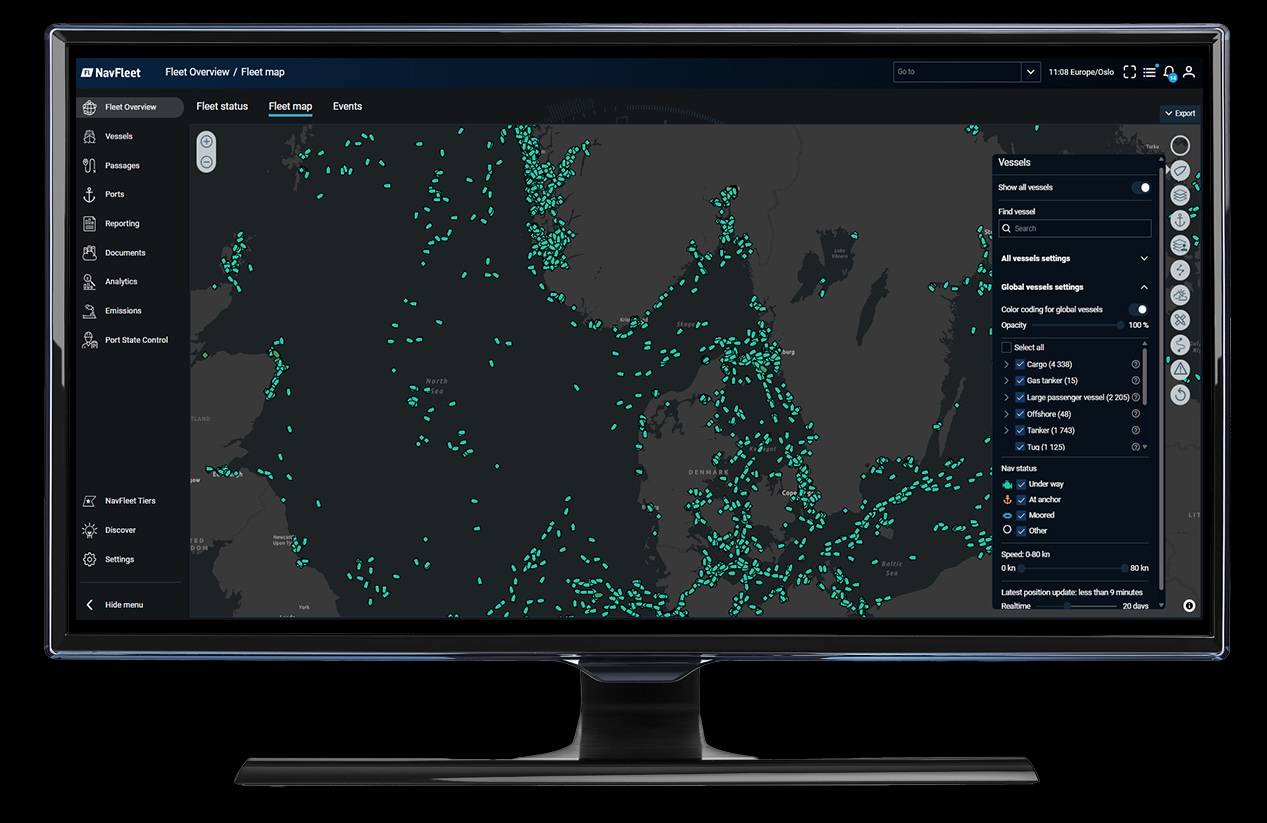
introduces real-time AIS streaming in NavFleet platform

NavFleet 2.7.1 - users now have the ability to zoom in on any vessel, anywhere, delivering new levels of operational insight and awareness
NAVTOR has introduced AIS streaming to its
NavFleet platform, allowing shipping companies to monitor vessel movements with
more frequent position updates and improved operational visibility.
The new functionality forms part of NavFleet
version 2.7.1, which is now available to existing monitoring subscribers. It
uses NAVTOR’s digital infrastructure to collect and transmit vessel AIS data,
helping shore-based teams track ships and surrounding maritime traffic.
According to the company, the system provides
access to vessel position, speed and heading information with minimal delay
compared with conventional AIS data services.
Enhanced fleet monitoring and operational
awareness
The AIS streaming capability uses NAVTOR’s
NavBox, an onboard gateway that supports data exchange between vessels and
shore-based operations.
Through this infrastructure, the platform can
transmit AIS information using a proprietary low-bandwidth network. Fleet
managers can then monitor vessel movements alongside surrounding traffic and
operational conditions.
In addition, NavFleet 2.7.1 introduces new
map layers covering environmental and maritime operating areas. These include
Important Marine Mammal Areas (IMMA), Whale Conservation Zones (WCZ),
Particularly Sensitive Sea Areas (PSSA) and IMO Special Areas.

NavFleet 2.7.1 with AIS streaming – a new world of fleet monitoring potential, with the ability to zoom in on any vessel in real-time
The update also improves file sharing and
coordination between onboard crews and shore-based management teams.
Tor Håkon Svanes, NAVTOR’s NavFleet Platform
Manager, said the new technology could support more informed and proactive
fleet management decisions.
The company believes faster AIS updates may
help operators identify potential risks, monitor port approaches and respond
more effectively to operational incidents.
NAVTOR is also developing a playback function
for future NavFleet releases. This would allow users to review historical AIS
movements and analyse vessel activity following incidents.
The latest upgrade builds on NAVTOR’s
existing fleet management technology, which has been adopted by shipping
companies including “K” LINE.
NAVTOR currently supplies digital navigation
and fleet management solutions to more than 18,000 vessels worldwide.
AIS streaming will also become available
through the NavFleet mobile application in December 2026.
DP World
launches China Africa Link weekly service

DP World’s Shipping Solutions AMEA business will launch the China Africa Link, a new weekly service designed to strengthen maritime connectivity between the Far East and the growing markets of East and Southern Africa.
The service is scheduled to commence in late
November 2026 and will give customers greater choice, enhanced market access
and more resilient supply chains.
The rotation calls at Shanghai, Ningbo and
Nansha in China, followed by Port Klang Westport in Malaysia, Dar es Salaam in
Tanzania, Maputo in Mozambique and Singapore, before returning to Shanghai.
It will carry machinery, electronics,
construction materials and automotive components from China, alongside African
exports such as agricultural products, minerals and other commodities.
The service is presented as a practical
example of DP World Marine Services’ Connected Trade Corridors approach, which
brings together maritime solutions, ports and inland transport to build more
integrated and flexible trade networks.
It also complements DP World’s investments in
African trade infrastructure, including a US$ 165 million expansion of the
Maputo container terminal intended to more than double its handling capacity,
and a commitment of more than US$ 500 million to modernise the Port of Dar es
Salaam.
Ganesh Raj, Global COO of Marine Services at
DP World, said that as global trade changes, customers need more than shipping
capacity: they need reliable connections, greater choice and the flexibility to
adapt.
He described the new service as bringing the
Connected Trade Corridors approach to life by creating smarter, more flexible
shipping networks that help keep cargo moving and support the continued growth
of South–South trade.
ESL
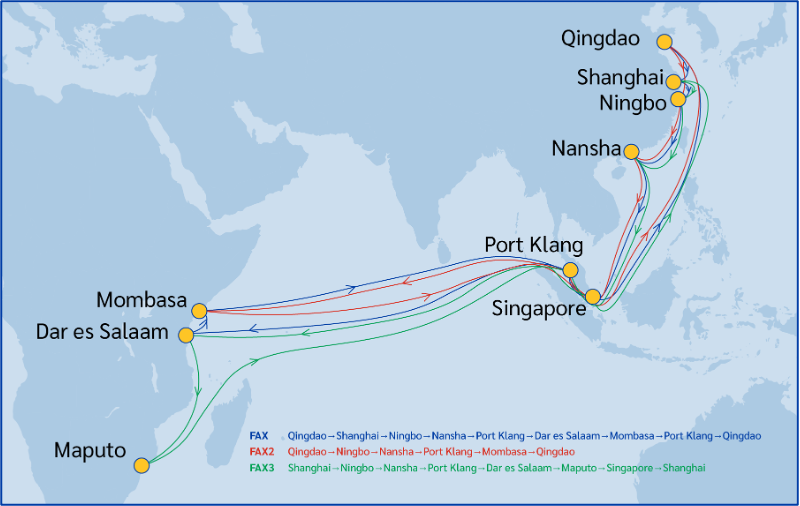
expands Far East-Africa network with FAX2 and FAX3 services
Emirates Shipping Line (ESL) will launch two
new services connecting major Chinese ports with East and southeastern Africa.
The new Far East Africa Express 2 (FAX2) and
Far East Africa Express 3 (FAX3) services will complement ESL’s existing Far
East Africa Express network.
The FAX2 service will connect Qingdao, Ningbo
and Nansha with Mombasa through Port Klang. Its first sailing is scheduled to
depart Qingdao on 5 December 2026.
The FAX2 rotation will be:
Qingdao – Ningbo – Nansha – Port Klang –
Mombasa – Qingdao
FAX3 will provide a direct connection to
Maputo, Mozambique. According to ESL, the service will also support access to
neighbouring markets, including Eswatini, Zimbabwe and South Africa.
The first FAX3 sailing is scheduled to depart
Shanghai on 25 November 2026.

The FAX3 rotation will be:
Shanghai – Ningbo – Nansha – Port Klang – Dar
es Salaam – Maputo – Singapore – Shanghai
The two services will operate alongside ESL’s
existing FAX service, which connects Qingdao, Shanghai, Ningbo, Nansha and Port
Klang with Dar es Salaam and Mombasa.
Grimaldi Lines Up 10
More Car Carriers in China, Including Record 11,000 CEU Vessels

Italian shipping group Grimaldi is planning a major expansion of its car carrier fleet, with proposed orders for 10 new pure car and truck carriers (PCTCs) at Chinese shipyards, including vessels with a capacity of up to 11,000 car equivalent units (CEU), which would be the largest in its fleet.
The Naples-based group has signed letters of
intent with China Merchants for five next-generation 10,000 CEU PCTCs and with
CSSC’s Guangzhou Shipyard International (GSI) for another five vessels, each
with a capacity of 11,000 CEU.
Both vessel designs will offer additional
capacity for containers and other rolling cargo, providing greater operational
flexibility beyond conventional vehicle transportation.
Pakistan Secured
Iranian Clearance for Qatari LNG Carrier Before Hormuz Attack

Pakistan had negotiated with Iran to secure safe passage for the Qatari liquefied natural gas (LNG) carrier Al Mayeda before the vessel came under a projectile attack near the Strait of Hormuz on Friday, according to people familiar with the discussions.
The Marshall Islands-flagged LNG carrier was
heading towards the strategic waterway with a cargo of Qatari LNG when it was
targeted.
Iranian authorities were understood to have
given the vessel clearance just hours before the attack, the sources said.
Following the incident, Al Mayeda reversed course and sailed back into the
Persian Gulf, according to ship-tracking data.
/// Air Cargo News
///
GMR Airports scales cargo operations
and posts record volumes

GMR Airports Limited reports record-breaking cargo volumes for Q2FY27, securing a major FedEx facility in Delhi and a European MoU for Hyderabad. BySTAT Times|30 Oct 2026 10:58 AM GMR Airports Limited (GAL) has demonstrated exceptional growth and strategic expansion within its air freight and logistics operations during the second quarter and first half of the financial year 2027.
The
company's dedicated focus on its cargo business platform has yielded
record-breaking handling volumes, significant infrastructure expansions, and
key international alliances across its portfolio of airports.
The
company's broader adjacency business strategy identifies cargo as a crucial,
perpetual business line that requires less capital intensity while offering
high revenue growth potential and economies of scale across both domestic and
international markets.
At
the forefront of this logistical growth is the Delhi International Airport
(DIAL), which successfully handled its highest-ever cargo volumes during both
the second quarter and the first half of FY27. Specifically, Delhi Airport
recorded a 12% year-on-year increase in overall cargo volumes, successfully
processing 0.63 million tonnes during the first half of the financial year.
This
surge in physical volume translated directly into strong financial performance,
with cargo revenues at Delhi Airport increasing by 15% year-on-year to reach
₹2.8 billion in H1FY27. Within the broader financial ecosystem of Delhi
Airport, cargo operations now account for a substantial 14% of the total
non-aeronautical revenue, which stood at ₹20.1 billion for the half-year
period.
To
further bolster its cargo infrastructure and service capabilities at Delhi
Airport, GMR Cargo and Logistics Ltd. (GCLL) entered into a significant licence
agreement with FedEx Express Transportation and Supply Chain Services (India)
Pvt. Ltd. This strategic partnership entails the operation of a dedicated
express cargo terminal located at Cargo City within the Delhi Airport premises.
The
groundwork for this expansion was laid earlier when GAL was granted the
concession to operate, maintain, and manage the existing cargo terminal at
Delhi starting in mid-May 2025, a transition that occurred following the
termination of the security clearance of one of the previous cargo operators.
Financially,
the Delhi Cargo business, operating as part of the GAL Standalone platform,
reported a total income of ₹2,368 million for Q2FY27, generating an EBITDA
(post-revenue share) of ₹676 million and a Profit Before Tax (PBT) of ₹646
million. For the entire first half of FY27, Delhi Cargo's total income reached
an impressive ₹4,707 million, yielding an EBITDA of ₹1,364 million and a PBT of
₹1,319 million.
Parallel
to the success in the national capital, Hyderabad Airport (GHIAL) also achieved
historic milestones in its air freight operations. The airport handled its
highest-ever cargo volumes, processing 52.0 thousand metric tonnes in Q2FY27
and approximately 102 thousand metric tonnes throughout H1FY27.
To
enhance its international logistics network, Hyderabad Airport signed a
Memorandum of Understanding (MoU) with Brussels Airport, a strategic move
designed to significantly strengthen air cargo connectivity and open efficient
trade lanes between Hyderabad and Europe. The cargo operations at Hyderabad are
managed by a 100% owned subsidiary of GHIAL.
This
dedicated cargo subsidiary reported a total income of ₹830 million for Q2FY27,
achieving an EBITDA of ₹321 million and a Profit After Tax (PAT) of ₹194
million. Over the six-month period of H1FY27, the Hyderabad cargo subsidiary
accumulated a total income of ₹1,679 million, an EBITDA of ₹708 million, and a
PAT of ₹445 million.
It
is also noteworthy from a regulatory standpoint that while cargo, ground
handling, and fuel farm revenues are traditionally treated as aeronautical
revenues as per the local Tariff Order, GHIAL recently secured a favourable
judgment from the Telecom Disputes Settlement and Appellate Tribunal (TDSAT) to
treat these segments as non-aeronautical revenues.
ATC Aviation strengthens expansion push
across Asia

The GSSA plans to expand its Asian network, strengthen airline partnerships, and tap growing air cargo demand driven by AI and technology shipments. BySTAT Times|3 Nov 2026 2:34 PM Ingo Zimmer, CEO, ATC Aviation Services AG ATC Aviation is expanding its presence across Asia, strengthening its regional network as the region emerges as an increasingly important driver of global air cargo growth.
Following
a recent visit to Seoul, Ingo Zimmer, Chief Executive Officer of ATC Aviation,
highlighted Asia's strategic importance to the company’s international General
Sales and Service Agent (GSSA) operations. He also underscored the region's
growing role in the company's expanding network. “Asia is a very important
market for us, and we believe much of the future growth in air cargo will come
from there.
We
intend to strengthen our position throughout the region and support our Asian
team by drawing on ATC Aviation’s global airline relationships, local market
expertise and more than 40 years of industry experience,” said Zimmer.
Worldwide GSA, which brings more than 30 years of industry experience and an
established presence across Asia and the Pacific, has joined the ATC Cluster.
The
group also includes Platinum in the US and Pacific Feeder Services in South
America. The ATC Cluster currently represents around 100 airlines across 42
countries and employs more than 300 people, generating annual revenue of over
€500 million.
In
addition to cargo general sales and service agent (GSSA) representation, ATC
Aviation offers passenger GSSA services in selected markets, along with
trucking, import and export support, and technology-related solutions. ATC
Aviation's regional growth is being driven by new airline partnerships across
several international markets.
Recent
additions to its customer portfolio include Delta Air Lines in Germany, WestJet
in Brazil, Air Europa in South Africa and Finnair in the United States. Zimmer
said the partnerships reflect airlines' confidence in ATC Aviation's
international reach, dedicated representation and strong local market
knowledge.
He
added that the company works closely with each airline to understand its
network, capacity and commercial objectives, providing tailored support to help
them achieve their growth plans. ATC Aviation's expansion strategy is built
around a dedicated-team model, in which each airline is assigned a clearly
defined point of contact through the company's “head of product” structure.
This
enables the GSSA to develop individual strategies for each carrier while
maintaining confidentiality and preventing potential commercial conflicts.
According to Zimmer, this approach requires greater investment than
conventional shared-sales arrangements but delivers added value to airline
partners through personalised attention and strategies tailored to their
specific priorities.
Emirates SkyCargo unveils AI Tech for
global AI hardware logistics

Emirates SkyCargo introduces AI Tech, a specialised logistics solution ensuring safe, priority-loaded and rapid global deployment of AI infrastructure. BySTAT Times|3 Nov 2026 12:14 PM In an era where the rapid proliferation of artificial intelligence relies entirely on the robust physical foundations supporting it, Emirates SkyCargo has officially launched AI Tech.
Announced
on 3 November 2026, this dedicated air freight product is purposefully designed
to help customers transport critical and highly sensitive AI infrastructure
safely, securely, and strictly on schedule. Tailored meticulously for the
nuanced requirements of AI server racks, advanced semiconductors, graphics
processing units (GPUs), and capital manufacturing equipment, the new offering
brings together priority loading, specialised cargo handling, and proactive
shipment monitoring through the carrier’s central command centre in Dubai.
As
computing and data processing systems worldwide reach unprecedented levels of
sophistication, the accelerating adoption of AI technologies has fundamentally
transformed global supply chains. Consequently, the movement of this highly
specialised technology equipment has grown increasingly complex. Large-scale
data centre build-outs and enterprise technology deployments routinely involve
exceptionally high-value cargo, severely compressed implementation timelines,
and rigorous handling parameters.
AI
Tech responds directly to these industry pressures by providing technology
customers with a focused, end-to-end logistics solution. This product is
underpinned by globally standardised operating procedures that encompass
priority loading privileges, enhanced oversight of shipments at every transit
stage, and highly proactive customer coordination throughout the entire
transportation journey.
Badr
Abbas, Divisional Senior Vice President, Emirates SkyCargo said: “Behind every
AI breakthrough is physical infrastructure that needs to arrive safely and on
time. AI Tech is designed to give customers confidence that their critical
equipment will move seamlessly across our network, supported by operational
oversight and proactive communication.
In
July alone, we transported more than 700 tonnes of AI infrastructure across our
global network, and demand has continued to grow. As this sector expands, our
ambition is to become the carrier of choice for companies operating across the
AI ecosystem.” To achieve this required level of reliability, Emirates SkyCargo
has engineered several key features into the core of the AI Tech proposition.
Central
to the service are globally standardised, dedicated handling procedures
explicitly designed to maintain specific equipment orientation during transit,
thereby minimising any risk of damage to delicate micro-components. For
time-critical deployments where installation schedules are measured in hours
rather than days, the product guarantees priority loading and expedited
scheduling.
Furthermore,
clients are granted comprehensive airport-to-airport shipment visibility,
receiving real-time milestone updates monitored relentlessly through the
airline's command centre in Dubai. This is seamlessly complemented by
specialist project cargo support tailored for oversized and unusually heavy
cargo consignments.
FedEx launches dedicated aircraft
engine logistics solution

A dedicated engine logistics solution combines specialised handling, digital tools and global connectivity to transport aircraft engines efficiently and minimise maintenance-related delays. BySTAT Times|30 Oct 2026 2:15 PM FedEx has introduced a dedicated engine logistics solution to strengthen its global aerospace capabilities, focusing on the transportation of aircraft engines and oversized aerospace components.
The
service is designed to provide faster, more precise and reliable movement of
critical aerospace equipment. The offering aims to address growing maintenance
demand, supply chain complexities and the need to maximise aircraft fleet
availability. It will help aerospace companies transport essential components
while minimising delays and disruptions linked to engine movement.
Marcus
Balzereit, president, FedEx Logistics, said, “When an aircraft engine needs to
move, every hour matters and every detail counts. A delayed engine can impact
flight schedules, aircraft availability, maintenance schedules, and operational
commitments across the aviation industry.
With
our own airline DNA, we understand firsthand the complexity and urgency behind
keeping aircraft flying. Our solution brings together dedicated aerospace
experts, digital innovation, and a proven global network to provide customers
with the speed, visibility, and reliability they need to keep operations
running efficiently.
FedEx’s
engine logistics solution is supported by a specialised team that handles
main-deck engine quotations and manages shipments from origin to destination.
Working with teams across its global network, the experts provide centralised
shipment oversight, regulatory compliance, customs coordination and end-to-end
management.
All
engine movements follow FedEx’s global operating procedures, with strict safety
and security checks to ensure engines are properly secured before departure.
The service is also supported by a proprietary digital platform that simplifies
quotation generation, automates customer communications and manages shipment
documentation securely.
The
solution addresses growing challenges in the aerospace sector, including
extended lead times, component shortages and increasing pressure to maintain
aircraft availability. By combining specialised handling with digital tools and
global connectivity, FedEx aims to improve shipment visibility, strengthen
supply chain resilience and reduce maintenance-related disruptions.
Since
June 2025, FedEx has transported hundreds of main-deck aircraft engines,
weighing several thousand tonnes in total. The experience, supported by its
global network and aerospace expertise, positions the company to provide
scalable and reliable engine transportation services.
Japan Airlines and CHAMP extend cargo
technology partnership

The renewed agreement will support JAL’s planned transition to Cargospot neo, an AI-enabled cargo management system designed to improve connectivity, automation and operational efficiency. BySTAT Times|28 Oct 2026 8:30 PM Japan Airlines (JAL) has renewed its partnership with CHAMP Cargosystems for multiple years, paving the way for the airline to transition from its current cargo management system to Cargospot neo.
The
renewed agreement marks the next phase of a 12-year partnership between the two
companies. It will help align JAL’s future business requirements with the
capabilities of Cargospot neo as the airline continues to digitise its cargo
operations. Cargospot neo is CHAMP’s next-generation cargo management system,
built on the CHAMP neo Platform.
It
uses an application programming interface (API)-based architecture and
artificial intelligence (AI) to bring operational, commercial and financial
processes together in one system. The platform is designed to simplify
integration between airlines, freight forwarders, ground handlers and
technology partners. It also aims to improve visibility, flexibility and
automation across cargo operations.
The
system’s AI capabilities are intended to support decision-making, capacity and
commercial planning, process management and faster responses to changing
customer and market requirements. It will also allow airlines to modernise
their operations while maintaining continuity. JAL and CHAMP have previously
introduced digital services to support paperless domestic cargo processes and
self-service facilities for JAL’s international and domestic partners.
These
services include APIs and mobile capabilities and run on CHAMP’s neo Platform.
JAL also uses several CHAMP solutions across its cargo network, covering core
operations, customs and security compliance, and business intelligence.
Manuel
Galindo, Chief Executive Officer of CHAMP Cargosystems, said the renewed
agreement reflected the strength of the partnership and the companies’ shared
ambition to advance air cargo operations.
He
added that the transition to Cargospot neo Airline would give JAL access to
AI-enabled cargo operations, digital sales capabilities and large-scale
connectivity with partners and channels.
I hope you have enjoyed reading the above
news letter.
Robert Sands
Joint Managing Director
Jupiter Sea & Air Services Pvt Ltd
Casa Blanca, 3rd Floor
11, Casa Major Road, Egmore
Chennai – 600 008. India.
GST Number : 33AAACJ2686E1ZS.
Tel : + 91 44 2819 0171 / 3734 / 4041
Fax : + 91 44 2819 0735
Mobile : + 91 98407 85202
E-mail : robert.sands@jupiterseaair.co.in
Website : www.jupiterseaair.com 1Branches : Chennai, Bangalore,
Mumbai, Coimbatore, Tirupur and Tuticorin.
Associate Offices : New Delhi, Kolkatta, Cochin &
Hyderabad.
Thanks to : Container News, Indian Seatrade & Cargo Forwarder Global.


Comments
Post a Comment