|
When people talk about the
moment air cargo proved what it could do, one story usually steals the
spotlight: the Berlin Airlift. The image is powerful, almost cinematic. A
city cut off from the rest of the world, a population on the edge, and
planes, one after another, keeping the spark of freedom alive with food,
medicines . . . and even coal. Indeed, that story deserves the attention and
admiration it received as both a great humanitarian effort and an adventure.
But it also hides something: Berlin was not the first time when air cargo
became a lifeline; it was the biggest headline for sure, not the first.
This was part of a longer chain of airlifts
that taught the world early on, one crisis at a time, that cargo could move
by airplanes when nothing else could move it. So in this chapter setting the
stage for what was to come next, Air Cargo Chronicles, begins as a three-act
story. Three airlifts, three eras, and one industry being born in real time,
sometimes heroically, sometimes messily, and always under pressure.
Act One takes us to World War
II. Before Berlin, before the Cold War symbolism, there was another supply
line carved into the sky: flights from Assam in India to Kunming in China,
over the Himalayan mountains. It was called “The Hump,” and that name does
not even try to soften its character. Japan had cut off the Burma Road, and
the Allies still needed to get munitions and supplies through to support
forces in China, including Claire Chennault’s Flying Tigers, the American
Volunteer Group. The problem was the route. “You weren’t cruising over
friendly terrain,” as it was put back then. You were threading aircraft over
peaks roughly twelve thousand feet high, in brutal weather, with violent
updrafts and thin margins for error. It was the kind of flying where a single
miscalculation could erase a plane and a crew into terrain no one could
easily reach.
 Some
of those wrecks, unbelievably, would still be discovered decades later in
remote places. That’s how unforgiving it was, and yet those flights happened,
again and again, moving what had to be moved because there was no other way.
But here is the twist which sets up everything that comes later: when the war
ended, a bunch of those same pilots did not just go home. They took the idea
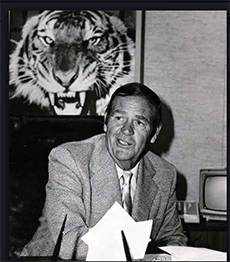
of air cargo and turned it into a business. The Flying Tiger Line, for
example, was founded in the U.S. by Robert Prescott (left)
and other pilots who had flown the Hump.
Even before Berlin then, the world had already
seen air cargo operate like emergency infrastructure, but in Act Two, the
stakes get even larger, and the whole planet starts watching . . .
West Berlin, 1948. The city with 2.5 million
people sits like an island deep inside a Soviet-controlled zone, about 110
miles inside from the nearest western area. After the war, the politics were
tense and unstable, and then came a decisive move toward currency reform,
meant to knit West Berlin more tightly to West Germany.
The Soviets would not allow an “oasis” of
Western economics and influence sitting there, right inside Eastern Germany.
So on June 24, 1948, they shut the gates: rail, road, water routes — all
blocked. An entire city suddenly cut off from its surroundings and its
connections. At that point, you can imagine the assumption: eventually, West
Berlin would have to concede. Because . . . how do you supply a major capital
city with no land access? That’s the moment the Allies made a choice that
sounded almost impossible: if the only way in and out is by air, then by air
it will be. What followed became the first truly heartfelt movement of air
cargo in history.
It was eggs and bacon and coal and milk: the stuff of life and the city lived
because air cargo did the job. With a bit of imagination: was Belin worth a
direct and immediate confrontation with Stalin’s USSR, or was there a way
about it to save Berlin and avoid the rapidly exacerbating cold war to become
red hot? Over roughly eleven months — until May 12, 1949 — 277,204 flights
hauled 2,185,247 tons, valued at about 224 million dollars in 1948 money: staggering
numbers that included more than 50,000 Germans at work fixing the aircraft,
essential for the airfreight of essentials: food, fuel, machinery, building
materials, you name it. And it wasn’t just the scale. It was the rhythm!
Planes landing and taking off so frequently that, at peak flow, every couple
of minutes another aircraft was touching down or lifting away from one of
three airfields: Tempelhof, Tegel and Gatow.
Tempelhof, especially, had this almost surreal
setup. It was right in the city center, basically at the end of an approach
that skimmed rooftops. This was before modern air traffic control as we think
of it, and there were real threats: reports of snipers taking random shots as
aircraft came in low. Especially appreciate all of this information is
straight from Journalists Edward Ansel Talbert and Richard Malkin, who were
both boots on the ground at Tempelhof and elsewhere at various times,
watching the epic story unfold for future generations to know. Their coverage
still hits hard: long stretches of monotony, then a short burst where
everything could go wrong at once: “Imagine trying to pin a four-engine
aircraft onto a tight strip, loaded with cargo that isn’t always perfectly
settled, while the situation on the ground is unpredictable. It was bravery,
yes. But it was also exhaustion. They flew around the clock with minimal
rest, and the cost was real: forty-nine airmen died during the operation.”
And yet, the planes kept coming.
Berliners, who only a few years earlier had
endured horrific bombing, gave these cargo aircraft a nickname that flipped
the meaning of an airplane overhead. Not destroyers nor providers, they
called them ‘Rosinenbomber’, i.e. “Raisin Bombers”. Eventually, the blockade
cracked under economic pressure and countermeasures. Talbert later pointed
out something striking: decades after, similar economic strategies would help
bring down communism more broadly. But in that moment, the Airlift ended with
a kind of quiet victory, proof that a city could be kept alive from the sky.
And this is where our story gets complicated,
because while newspapers were full of heroic headlines, another battle was
brewing, one that would shape air cargo long after the last Berlin flight
landed. By the late 1940s, air cargo companies already existed, but many were
unscheduled operators, basically flying when they had the demand meeting the
aircraft. There were players like Seaboard and Western, which later became
Seaboard World Airways. In fact, they claimed a milestone: the first
departure ever from the newly opened Idlewild Airport—today’s JFK—on July 9,
1948.
They weren’t alone. You had the aforementioned
Flying Tigers flying from USA East coast to Asian destinations: Slick, Riddle
and a whole crowd of ambitious outfits, often built around surplus warplanes
and ex-military pilots who believed cargo had a future beyond emergencies.
But the big established passenger airlines were also in the cargo game,
supported by passenger revenue and air mail structures. Some ran cargo
services at a loss, racing rates down to levels that would sound shocking
today.
During the summer of 1950 the Korean War was
moving fast, and not in a good way. United Nations and South Korean forces
were falling back under pressure, and everything they needed to keep fighting
was to arrive now, not next month. That was when a massive, tightly organized
aviation effort kicked into gear: the Pacific Cargo Airlift, running from
1950 to 1953.
This third airlift post WW II
airlift was built like a two-part machine. First it was a strategic airlift:
getting people and equipment from the United States across the Pacific to
Japan. Then tactical airlift: moving those same resources from Japan straight
into the Korean combat zone, where timing could decide whether a position
held or collapsed. The backbone was the U.S. Military Air Transport Service,
(MATS). Starting in July 1950, MATS began rushing troops, vehicles,
ammunition, and all the unglamorous essentials that wars burn through: fuel,
rations, spare parts and more.
A monumental example of airlifted emergency
cargo were the shipments of lethal bazookas which stopped the T-34 tanks dead
in their tracks before they could sweep across the whole face of lower Korea.
When a shortage of batteries threatened the United Nations communications
system on the front, it was air transport, not sea transport, which could be
depended on to make rapid delivery. During the early, chaotic fighting around
the Chosin Reservoir and the Hungnam withdrawal, cargo planes pivoted into a
reverse airlift with evacuation work, moving wounded personnel and hauling
out ammunition and supplies so they would not be lost.
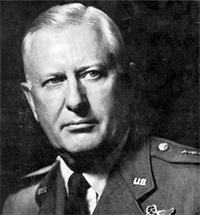 By
September 1950, MATS flights were logging about 250,000 airplane miles every
single day as MATS boss Major General William H. Tunner (right)
established the Combat Cargo Command. That was a key turning point, because
it brought the whole system under one central structure, tying together the
long-haul routes and the in-theater shuttle runs. By the time fighting ended,
in July 1953, the Pacific Airlift had transported about 214,000 passengers
and evacuated more than 43,000 casualties. Intra-theater and front-line
delivery operations alone moved 391,763 tons of material in 210,343 missions.
At its peak, air cargo delivery reached up to 1,100 tons of supplies per day.
Not to be forgotten, nine of the 17 U.S. commercial airlines joined the
effort adding aircraft. The ramp of United Nations airplanes looked like an
exhibit of the worlds air carriers: Northwest, Pan American, Canadian
Pacific, Sabena, California, Eastern, Alaska Airlines, even some others,
obscured by time. But whatever their markings, they were all MATS planes for
that moment.
“One outstanding example of airlifted emergency
cargo were several all-cargo shipments of lethal bazookas weapons, which
stopped the onrushing T-34 tanks dead in their tracks before they could sweep
across the whole face of lower Korea”, Richard Malkin reported.
We quote this information twice, because it is the real epitome of the
feelings in those moments.
It was the same story as war blazed all over
Korea. Short supply from small arms to blood supply to delivery of a 600-ton
steel bridge, all was met by MATS and its brave, intrepid pilots from the
military and commercial airlines.
Three airlifts! An expressway in the sky, moving air commerce in wartime
then, like a forwarder connecting shippers at the dawn of modern aviation
when the war ended, commerce thriving ever since. Something we should think
about today: the efforts that were deployed by the U.S. and their allies then
to re-build a frayed peace developed into the greatest trade development of
all times. We are lucky today that we just need to let it flow!
|




Comments
Post a Comment